Understanding climate change and the global energy system is hard. New claims arrive faster than we can make sense of them. Hot takes crowd out credible context. And without a solid foundation, knowledge can fall away – like a tree without a trunk.
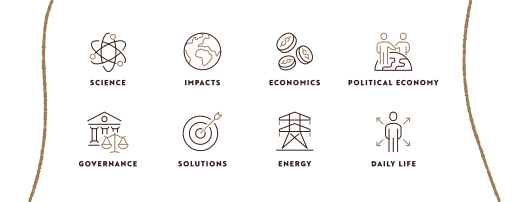
That’s the idea behind Climate Trunk. A growing library of visual explainers that holds the big picture together – from science and history to impacts and justice, and from societal net zero to our spheres of influence. Each ring adds coherence and context.
The metaphor works two ways. Like a tree trunk, it records our climate and energy story in its rings as it grows over time. It also works like a storage trunk, safeguarding and organising the knowledge you can carry with you and come back to.
The Trunk grew out of years of trying to cut through the noise – reading the science, the politics, the arguments, the spin, and realising how easily new information slips away without the right frame. The answer became obvious: start with an image and build everything else around it. Because visuals anchor memory better than words alone, most of that ‘everything’ is infographics.
The Trunk is designed to help you understand and remember what matters, and to stay grounded when that next wave of confusion rolls in. It’s also here to help you navigate misinformation and those familiar deflection arguments that keep resurfacing. You know them:
Stabilising our climate is the story of this century, whatever AI has to say. The Trunk helps you see it clearly.
Climate Trunk is inspired by those who combine expertise with clarity: Katharine Hayhoe's use of metaphors to meet people where they are, Richard Black's clear-eyed communication and logic, Michael Liebreich's hard-headed energy realism, Bryony Worthington's no-nonsense approach to climate policy, and the climate science of Zeke Hausfather, Kate Marvel, Joeri Rogelj, Sonia I. Seneviratne, Myles Allen and numerous others.
Substantively, the Trunk draws on the scientific synthesis of the IPCC’s sixth assessment report, the patient myth-busting of Skeptical Science, the open data and visual storytelling of Our World in Data, and the comprehensive explainers produced by Carbon Brief. And, of course, the many discussions with my colleagues at the Energy and Climate Intelligence Unit, Net Zero Tracker, Oxford Net Zero and Kiwis in Climate.
Visually, it takes inspiration from Information is Beautiful and xkcd. The Trunk itself? That comes from a master communicator, Wait But Why’s Tim Urban:
'I’ve heard people compare knowledge of a topic to a tree. If you don’t fully get it, it’s like a tree in your head with no trunk—and without a trunk, when you learn something new about the topic—a new branch or leaf of the tree—there’s nothing for it to hang onto, so it just falls away.'
Climate Trunk aims to make these topics easier to understand without sacrificing rigour. I aim for 100% accuracy – if I get something wrong, I’ll correct it openly.
Uncertainty is handled explicitly, sources are transparent and further reading trees under each graphic allow readers to explore topics in more depth.
My name's John Lang and I like turning climate science, energy trends and political economy into clear explainers. Climate Trunk is what I wish I'd had when first trying to make sense of everything.
I'm from Aotearoa New Zealand and work as an analyst at the London-based Energy & Climate Intelligence Unit, where I co-founded and lead the Net Zero Tracker. Over time, visual explainers have become central to how I communicate: from unpacking COP negotiations and IPCC reports – e.g. Worlds Apart (Special Report on 1.5°C) and AR6 Synthesis Report – to making sense of corporate net zero and how far climate action has come.
I’m an Oxford Net Zero Associate and founder of Kiwis in Climate, a 400-strong global network of New Zealanders working across climate, energy and related fields. In 2026, we published a book bringing together climate stories from Kiwis around the world.