Solar’s going bananas and this is only the beginning.
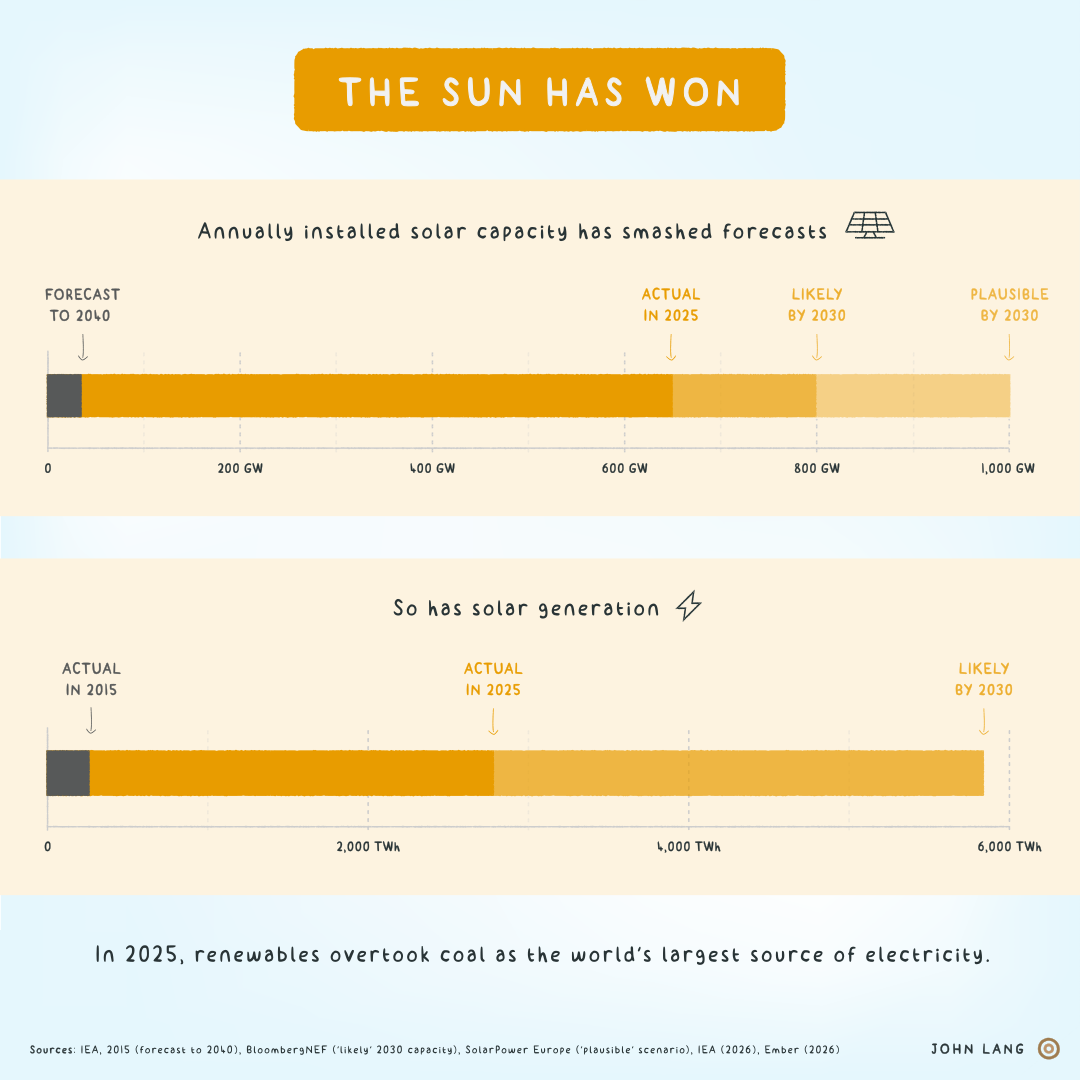
In 2015, the International Energy Agency (IEA) expected the world to add about 34 GW of solar each year through to 2040. In 2025 the world added 650 GW, an 1,800% increase on that linear prediction. BloombergNEF now expects annual additions approaching 800 GW a year by 2030, while high-end scenarios are nearing one terawatt annually, almost 30 times the IEA's 2015 expectation.
That explosion in installed capacity is translating into generation. In 2025, solar leapt 30% from 2024, producing almost 2,800 TWh globally – about as much electricity as the EU consumes in a year. This allowed clean power to meet all new electricity demand growth – even amid surging demand from data centres – nudging fossil generation into a slight decline. For the first time in over a century, that helped renewables (34%) overtake coal (33%) in the global electricity mix.
The learning machine
This is a story about manufacturing rather than extraction. Fossil fuels need to be dug up, transported and burned, and so the cycle repeats. Solar panels are built once and generate electricity for decades. Like semiconductors and microchips, solar follows learning curves: as production scales, costs fall. Every doubling of global cumulative solar capacity has historically reduced costs by about 20% – Wright’s Law in action, echoing Moore’s Law in computing.
Solar PV costs have fallen around 99.9% per watt in the last 50 years, and by roughly two-thirds in the last decade. Energy expert Saul Griffith likes to point out that Australian rooftop solar is ‘the cheapest retail energy ever delivered to consumers.’
Australia shows what happens when cheap solar scales. Since fossil generation peaked there in 2009, it has fallen 23% despite electricity demand rising 14% over the same period, with coal generation down by a third. Solar and wind generation have meanwhile grown twentyfold and now supply one-third of the country’s electricity.
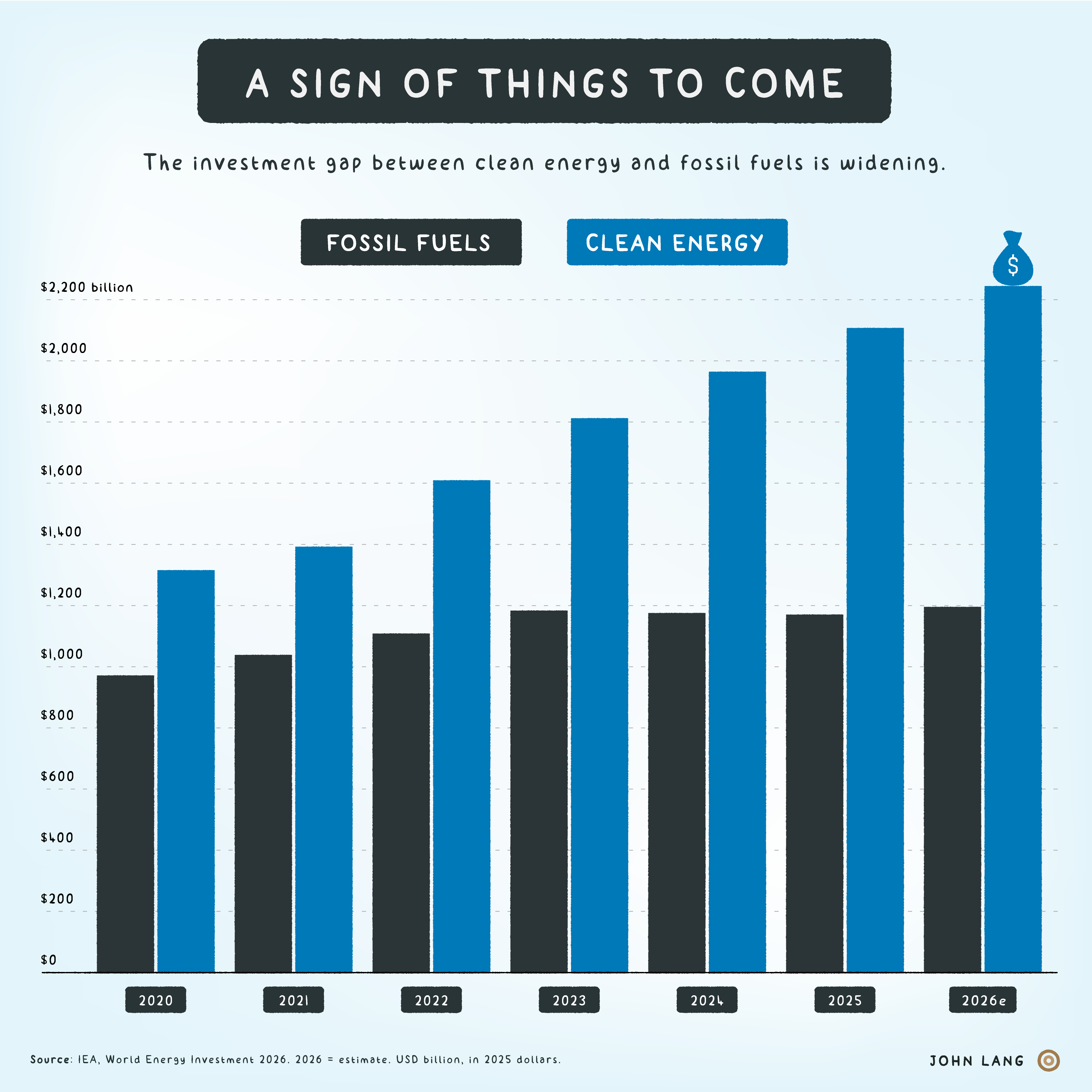
Even in Trump's US, solar and batteries continue to dominate new power additions because they increasingly outcompete fossil fuels on cost.
Critics sometimes point to solar’s lower capacity factors, grid constraints or the fact the sun doesn’t always shine. But this ignores the ‘killer app’ of the energy transition: the exponential build-out of solar paired with plunging battery costs. We are witnessing the transition from daytime solar to anytime solar in real time.
Battery costs fell a staggering 45% in 2025 while deployment grew 46% to an estimated 250 GWh. The world installed enough battery capacity in 2025 alone to shift around 14% of new solar generation from midday into other hours of the day.
Analysts now expect solar to overtake nuclear, hydro and wind in 2026, gas in 2031 and coal by 2033, becoming the world’s single largest source of electricity.
In the blink of an eye, solar and batteries are becoming the backbone of a new electricity system. They're scaling faster than grids, markets and policymakers can adapt.
Solar’s rise is the defining energy story of our time.