Climate scientists Katharine Hayhoe and Kimberly Nicholas have long boiled it down to five phrases: It’s real. It’s us. It’s bad. We’re sure. And we can fix it.
This framing has helped millions cut through a topic swamped by jargon, acronyms and complexity. The first four Climate Trunk graphics owe a debt to that tradition.
You’ll notice below I leave one off: we’re sure. Not because scientific certainty doesn’t matter. It does. The evidence is overwhelming. Scientists have passed the gold standard of certainty on human-caused climate change: the five-sigma level. The scientific consensus is as solid as gravity – and like gravity, it doesn’t care what you believe.
I just don’t want to start on the defensive. I want to start by showing the big picture as simply as possible – ‘we’re sure’ will get its own graphic later.
With that caveat out of the way, here’s the Trunk version of the really big picture:
1. It’s real.
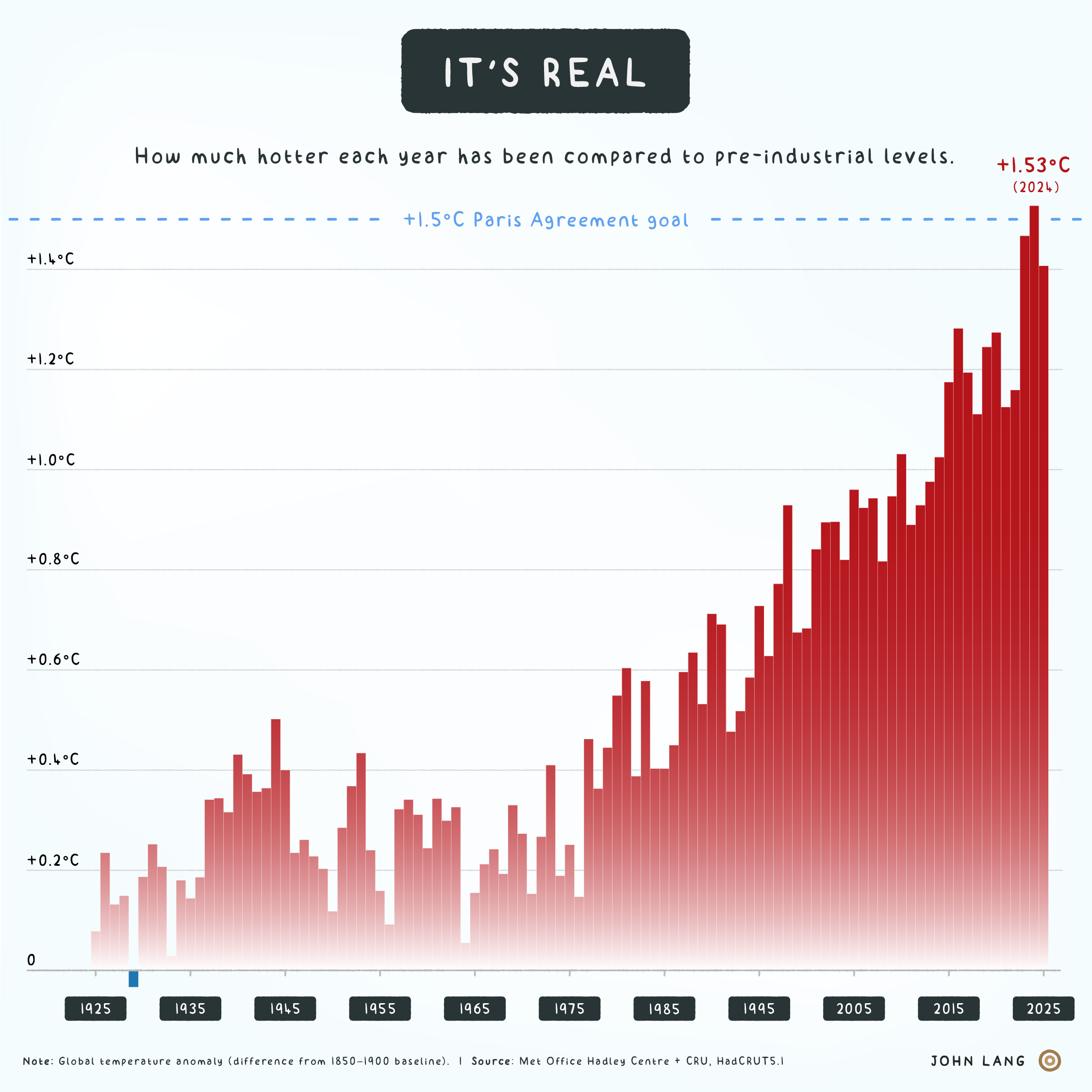
Global temperatures are rising, and faster than most people realise. The planet has heated by around 1.3°C since the late 19th century, with the bulk of that increase concentrated in the last 50 years. Land – where people tend to live – has heated by about 2°C on average already. (Ocean takes longer to heat up than land.)
In 2024, the global average reached 1.53°C above the pre-industrial baseline. That doesn’t mean the 1.5°C temperature goal of the 2015 Paris Agreement has been breached, since that threshold refers to the long-term average, not a single year. But it’s a warning that we’re inching closer.
2. It’s us.
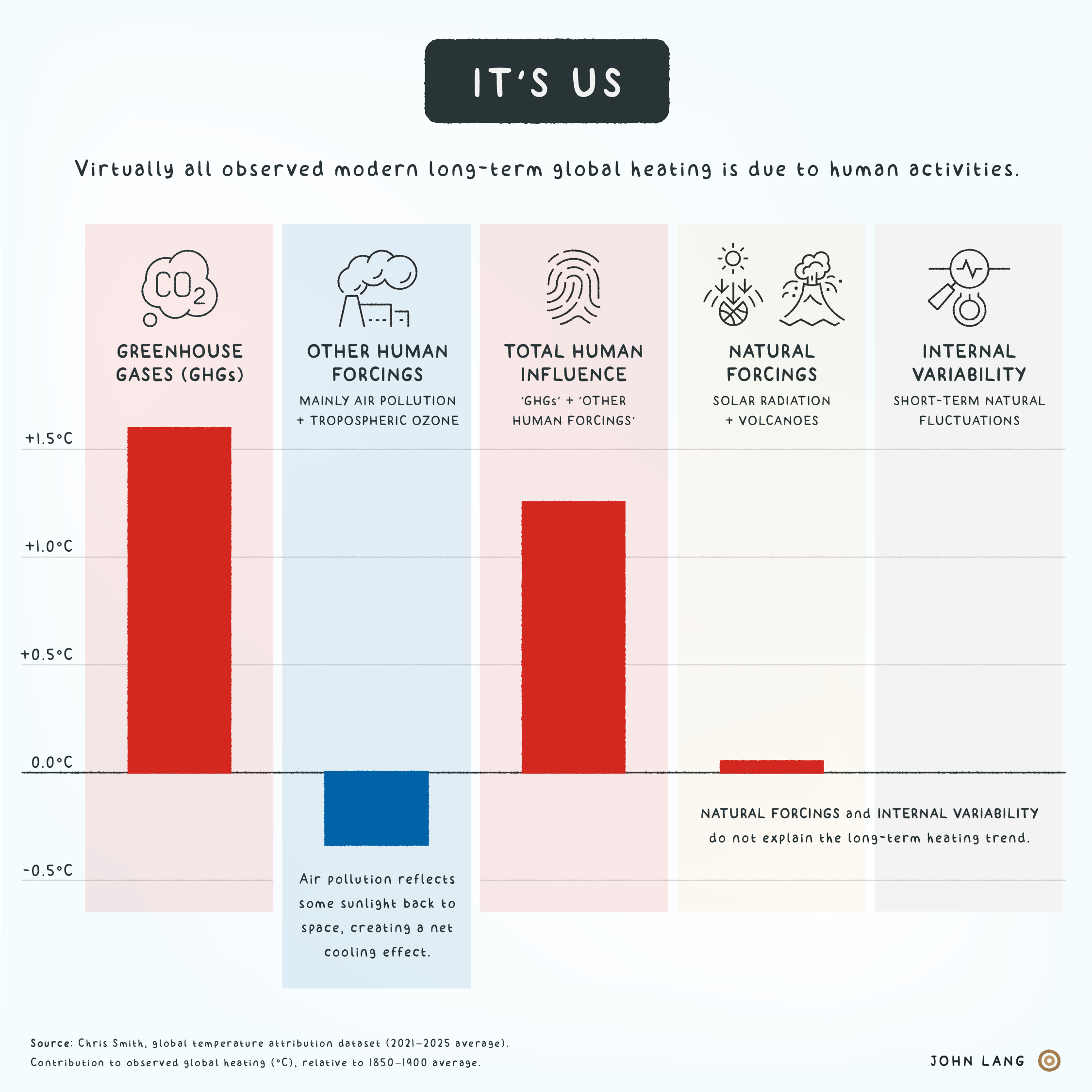
Modern global heating is overwhelmingly caused by human activity. The best estimate of the human contribution is around 100%, and possibly a little more, because natural factors have likely had a slight cooling influence over the last 50 years or so.
Our greenhouse gas emissions, namely CO2, acts like an extra blanket, trapping more heat. Meanwhile, air pollution has removed a little of that blanket by reflecting some sunlight back to space, but only temporarily. Natural factors like the sun and volcanoes do not explain the long-term heating trend.
As the IPCC puts it: ‘It’s unequivocal that human influence has warmed the atmosphere, ocean and land.’
3. It’s bad.
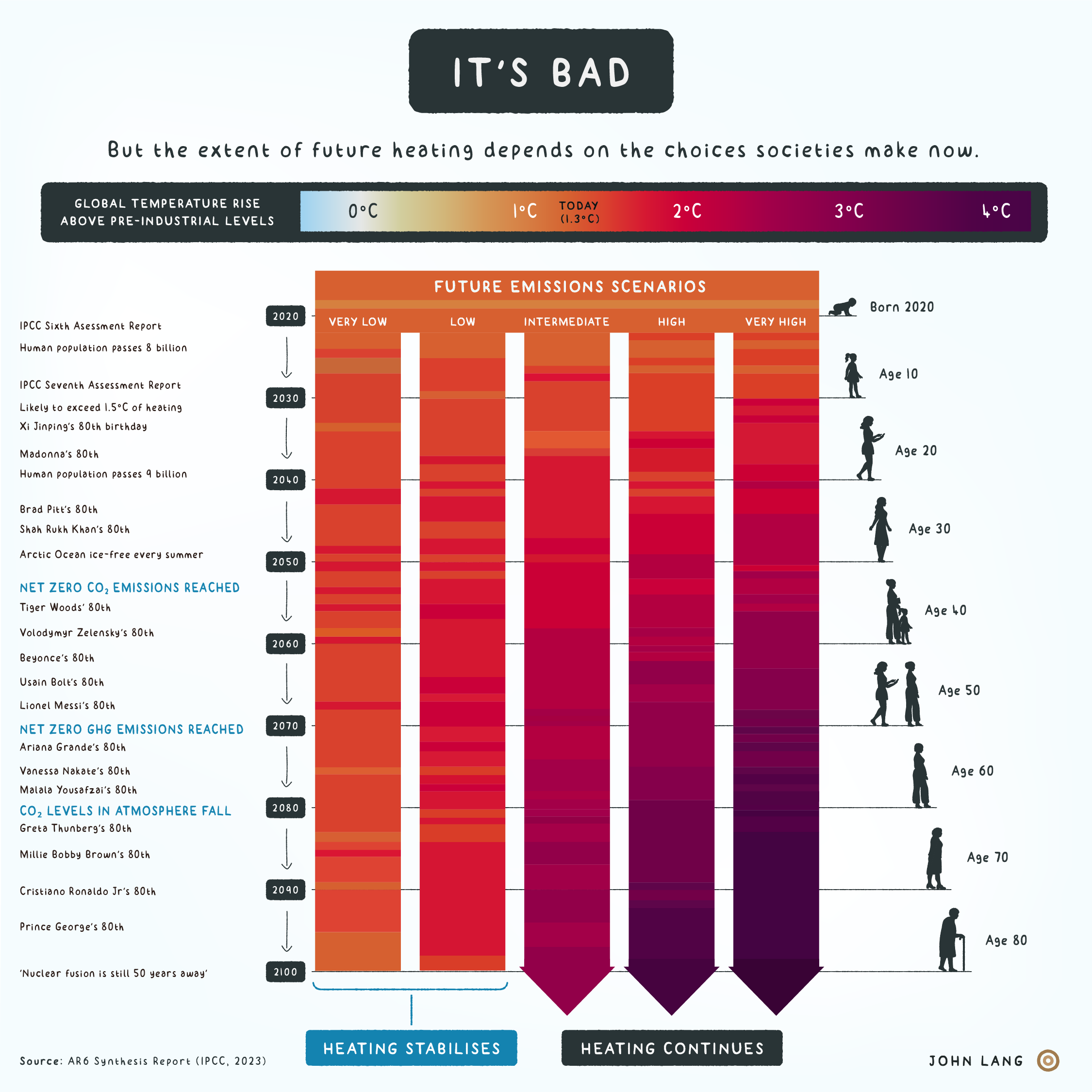
Climate change is not just a rise in temperature. It's a destabilisation of the conditions under which human civilisation developed. Food systems, water supplies, infrastructure, ecosystems and political institutions were built under, and for, a relatively stable climate. That stability is now being disrupted at speed.
The risks rise with every increment of heating: more extreme heat, heavier rainfall, worsening droughts, greater strain on nature and growing odds of ‘double whammy’ shocks across societies. The future is far from pre-written, but it will branch according to the choices made by governments over the next decade or so.
This is the part that sometimes gets lost, between ‘it’s too late’ and ‘everything’s fine’. Or, as the late scientist Stephen Schneider put it: ‘the “end of the world” or “good for you” are the two least likely [climate] outcomes.’
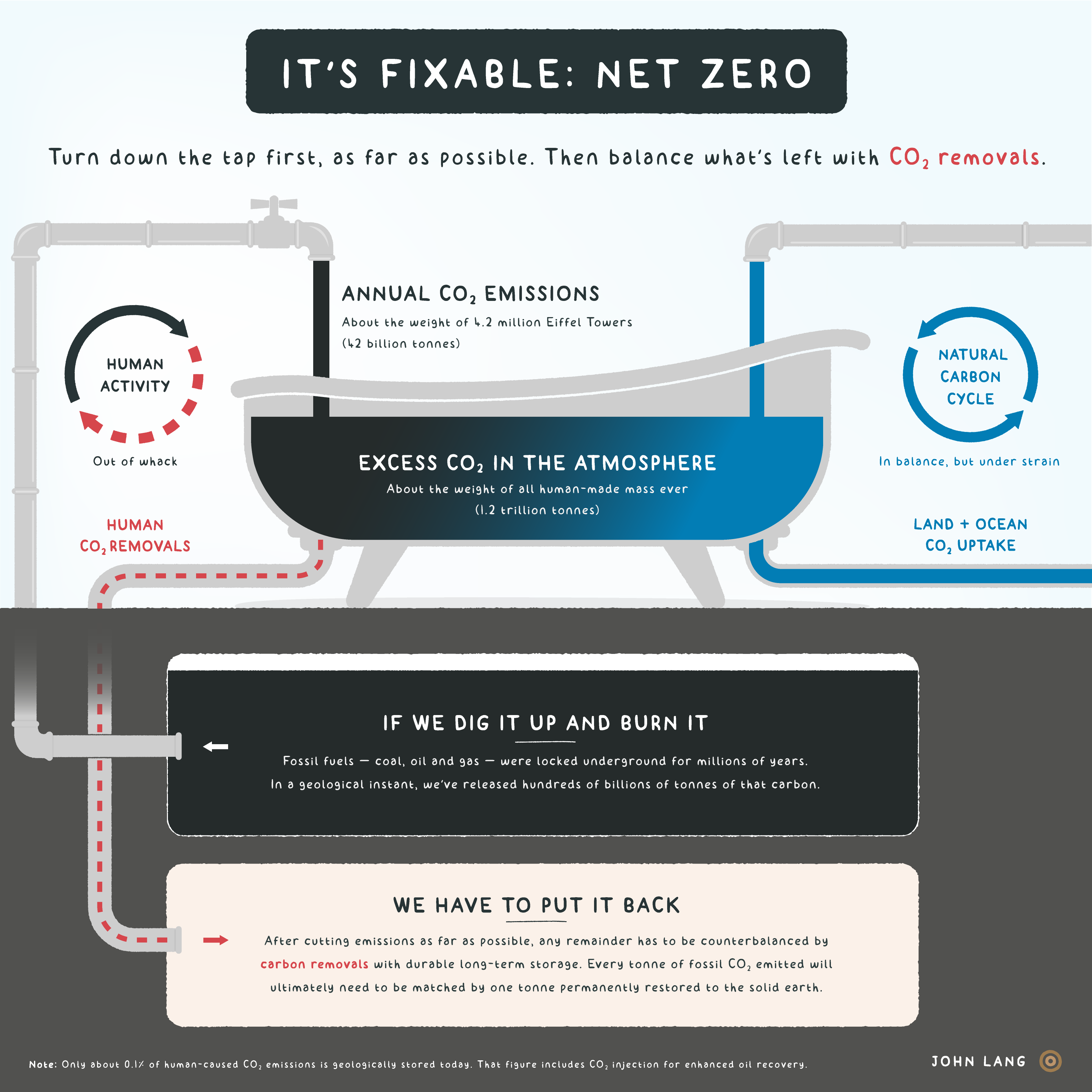
We know that achieving net zero CO2 is the only way to stabilise rising temperatures, and the first step towards net zero greenhouse gases. Net zero means cutting emissions as far and as fast as possible, then using durable removals to counterbalance what’s left. It also means protecting the land and ocean sinks that already absorb about half of our CO2 emissions.
Durable removals will help – they have to. But emission reductions will do the heavy lifting. Cutting emissions now is almost always easier and cheaper than trying to remove them from a sprawling atmosphere later.
The practicalities of net zero are, in fact, almost as simple as Hayhoe and Nicholas’s five climate basics. In a nutshell, we need to:
The good news is the first two above are underway, and moving faster than many expected.
Clean energy is beginning to grow in line with – and at times faster than – energy demand, the key to squeezing fossil fuels out over time. Slowly at first. Then all of a sudden.
Solar has gone bananas. Together with wind, it now accounts for more than 90% of new power capacity. Clean electricity has surged past 40% of global generation, helping put a brake on CO2 emissions growth since 2015.
The norm-wrecking ball in the White House has dented investment confidence. That there is no question. But global spending on clean energy is roughly double that of fossil fuels – and growing. Meanwhile the Iran crisis is rewriting energy policy in real time: away from imports and volatility, and towards energy sovereignty, stability and lower fuel import bills.
As veteran energy analyst Michael Liebreich reminds us, we’re already one-third through the energy transition in final energy terms: ‘the transition is considerably more advanced than its detractors would like us to believe.’ And on emissions, a China-led plateau should soon translate into a structural global decline.
Which brings us back to the single most important of Hayhoe and Nicholas’s basics: we can fix it. Progress is becoming visible. The supertanker is turning – even if you can’t feel it yet.
Net zero isn’t a political slogan or fodder for a culture war. It’s physics and chemistry, and our only way to stop global heating.