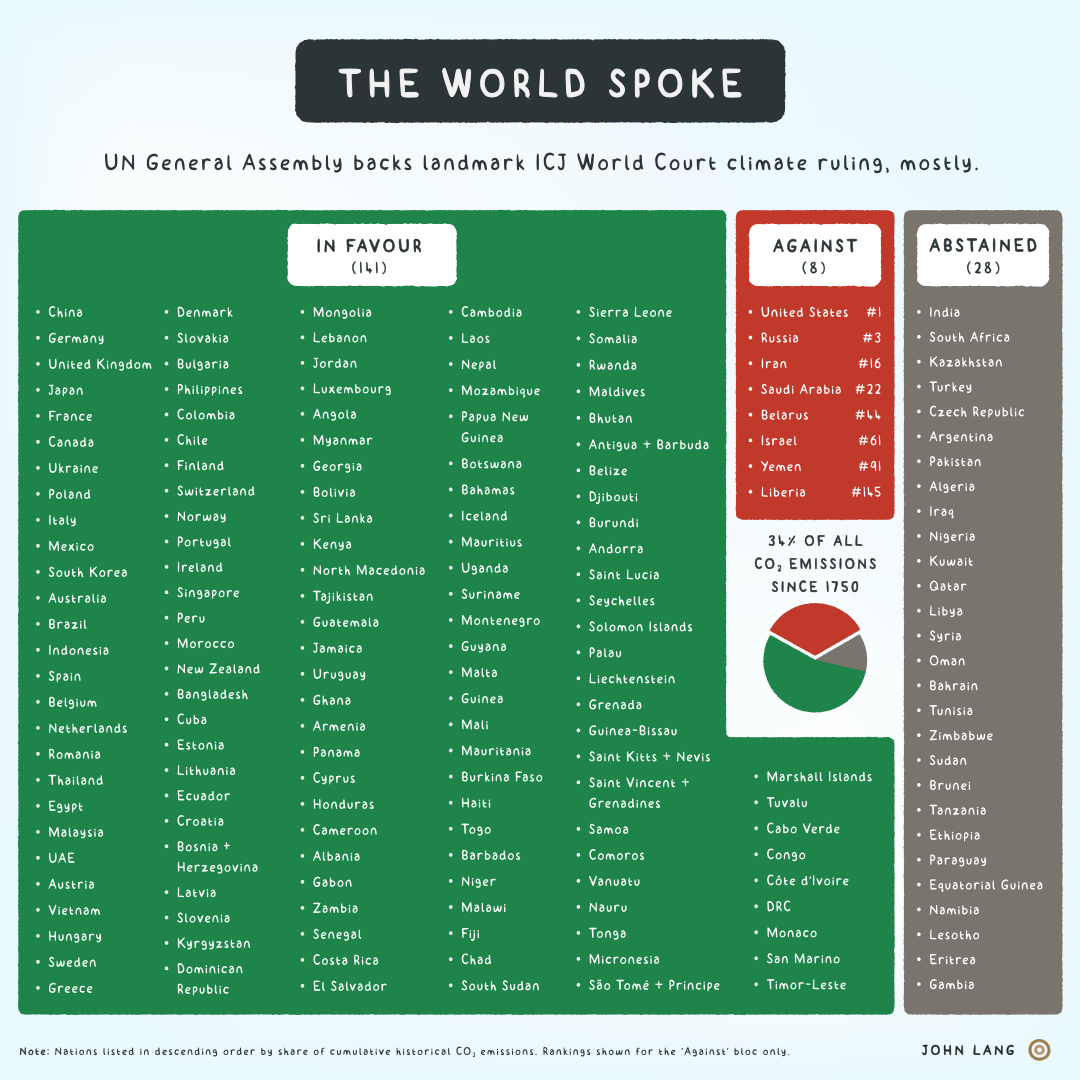
The UN overwhelmingly backed the ICJ World Court’s climate ruling.
What the Court said
The International Court of Justice (ICJ) delivered its landmark climate ruling in July 2025, concluding that States have a duty to prevent significant harm to the climate system under international law. It found those obligations arise across climate treaties, customary international law, environmental law and human rights law.
The Advisory Opinion on the Obligations of States in respect of Climate Change holds that breaches of these obligations ‘may constitute an internationally wrongful act attributable to that state.’ Depending on the circumstances, governments could be required to cease unlawful conduct, provide guarantees of non-repetition or make full reparation where harm can be established. It also ‘applies to all States’, irrespective of participation in climate treaties (particularly relevant after the US’s decision to withdraw from both the Paris Agreement and broader UN climate framework).
ICJ advisory opinions are not formally binding. But they carry legal and moral authority and help shape the interpretation and development of international law. The law ‘travels’ over time, even if some rulings cannot be enforced directly. The ruling is already being cited in climate litigation and climate-related rulings around the world. Courts may now cite the opinion when interpreting domestic climate law, while litigants could use it to challenge inadequate climate targets, fossil fuel expansion or failures to regulate major emitters.
The world responds
In May 2026, the UN General Assembly (UNGA) adopted a follow-up resolution. Led by Vanuatu and other countries, the resolution passed with 141 votes in favour and eight against. There were 28 abstentions, including COP31 host Turkey. The vote reinforced the idea that tackling climate change is evolving from a political choice into a legal duty under international law.
The eight countries voting against were the US, Russia, Iran, Saudi Arabia, Belarus, Israel, Yemen and Liberia. The figures beside their names above show each country’s rank by cumulative historical CO2 emissions since 1750.
Together, they account for one third of historical emissions despite representing only a tiny fraction (4%) of UN member states. The bulk of that total comes from the US (#1, 435 billion tonnes) and Russia (#3, 123 billion tonnes).
Historical emissions are central to questions of climate responsibility, contribution to heating and climate justice. Once CO2 gets into the atmosphere it is incredibly long lived: about half of what we emit today will still be in the atmosphere in 100 years, and a small fraction will persist for up to 400,000 years.
UN Secretary-General António Guterres described the UNGA vote as a strong affirmation of international law, climate justice and States’ responsibility to protect people.
‘The world’s highest court has spoken,’ Guterres said after the vote. ‘Today, the General Assembly has answered.’