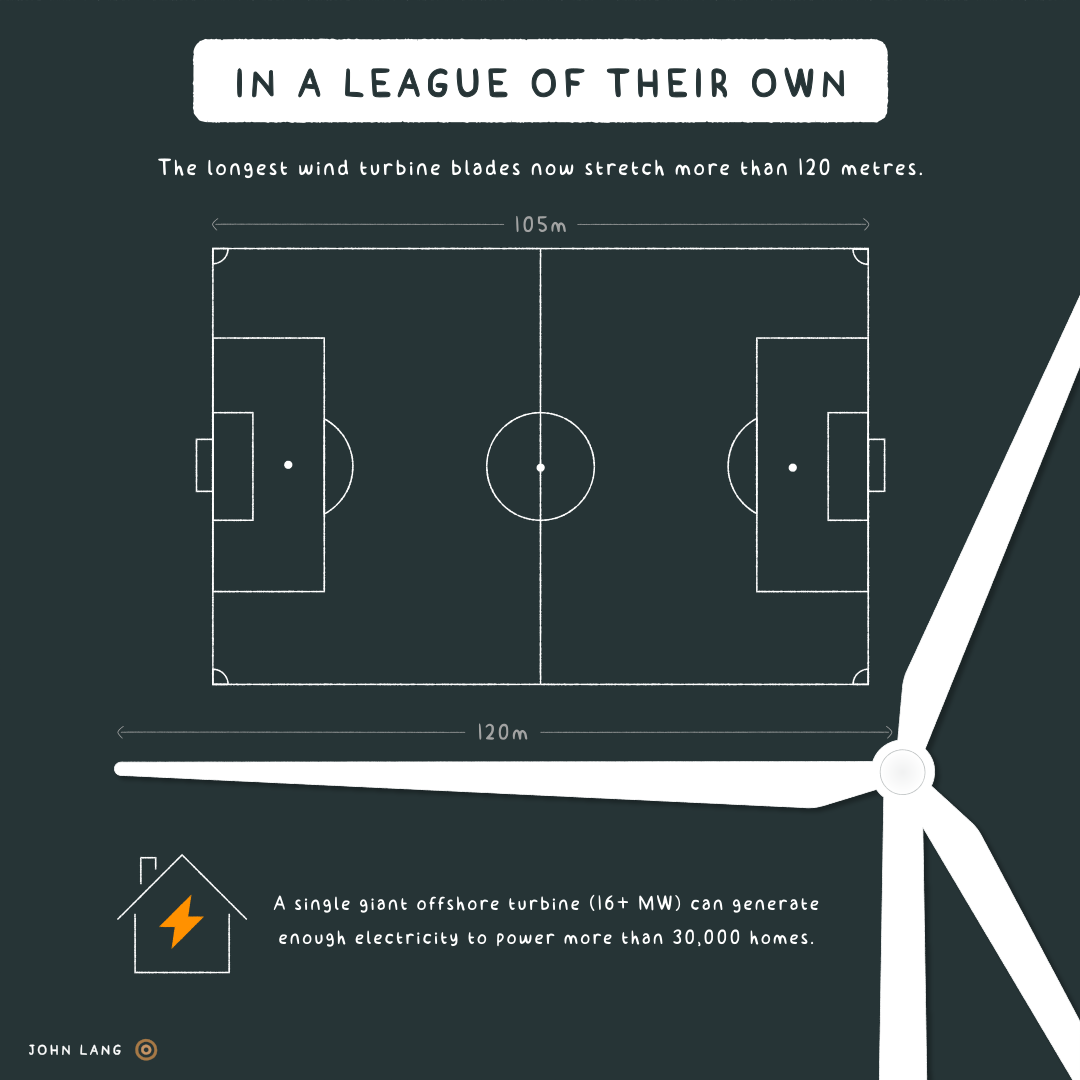
The longest wind turbine blades have grown to 120+ metres, longer than a football pitch.
The world's largest offshore wind turbine in operation has blades measuring 123 metres each and a rotor diameter of 252 metres. A Chinese manufacturer recently unveiled a 26 MW prototype with 153-metre blades and a rotor diameter of 310 metres. From sea level to upper blade tip, these structures are now about as tall as the Eiffel Tower.
In two decades, wind power has evolved from 4-megawatt (MW) machines to giants between 16 and 20 MW, each capable of generating enough electricity for tens of thousands of homes. Longer blades capture more wind and generate more power. In the US, the newly completed SunZia project combines more than 900 onshore turbines with a 900-kilometre high-voltage direct current (HVDC) transmission line, delivering enough electricity to supply roughly three million people (one million homes). At 3.5 gigawatts (GW), it’s about three times larger than the US’s next-biggest wind project.
Building wind infrastructure at scale isn't straightforward. Blades longer than 100 metres require specialised manufacturing and transport, while transmission lines often spend years navigating a maze of planning processes, legal disputes and permitting battles. Proposed in 2006, SunZia took nearly two decades to reach operation. It was ultimately built in one of America's strongest wind corridors, where consistent winds deliver above-average capacity factors – meaning its turbines will generate power closer to their maximum possible output. Offshore turbines have enjoyed repeated growth spurts in part because they encounter fewer land-use conflicts.
The story of wind deployment is also about bigger grids. SunZia's HVDC transmission line allows electricity generated in New Mexico to travel hundreds of kilometres to Arizona and California with far lower losses than conventional alternative current (AC) transmission. As renewables scale up further, building wires and batteries is becoming as important as building clean generation.
Global annual investment in renewables is now above $665 billion, including around $200 billion for wind projects. In the US, however, the political winds are blowing in the opposite direction.
The market is more powerful than a man
Before America's largest-ever wind project entered operation, President Trump said that wind power was 'the most expensive energy there is' and promised his administration would pursue a policy where 'no windmills are being built'. Wood Mackenzie, a consultancy, reckons US wind installations could fall by 17% by 2030 under new policy settings, even as electricity demand rises from more EVs, more cooling and (many) more data centres.
Today's energy transition depends on the scaling of 'electrotech' – wind, solar, batteries and the grids that tie them together. Clean energy already attracts twice as much investment as fossil fuels and solar is scaling faster than any energy technology in history. Crucially, unlike fossil fuels, renewables become cheaper as they scale. Wind and solar alone have met more than 90% of global electricity demand growth recently, and more than 100% in 2025.
When new demand is met by clean energy rather than fossil fuels, year on year, that’s how an energy transition happens.