Every time the world doubled its installed solar capacity, panel prices fell by about 20%.
Solar is by far the cheapest source of new electricity globally. Like learning any new skill, us humans get better with practice. Every panel we built has helped make the next one cheaper.
Pioneered by Theodore Wright in 1936, Wright's Law describes how costs fall as cumulative production rises. Economists call this relationship a learning curve. The same pattern has driven down the cost of other manufactured goods like computer chips and flat-screen TVs. Lithium-ion batteries have followed similar learning curves, helping make solar-plus-storage competitive with fossil fuels in most parts of the world.
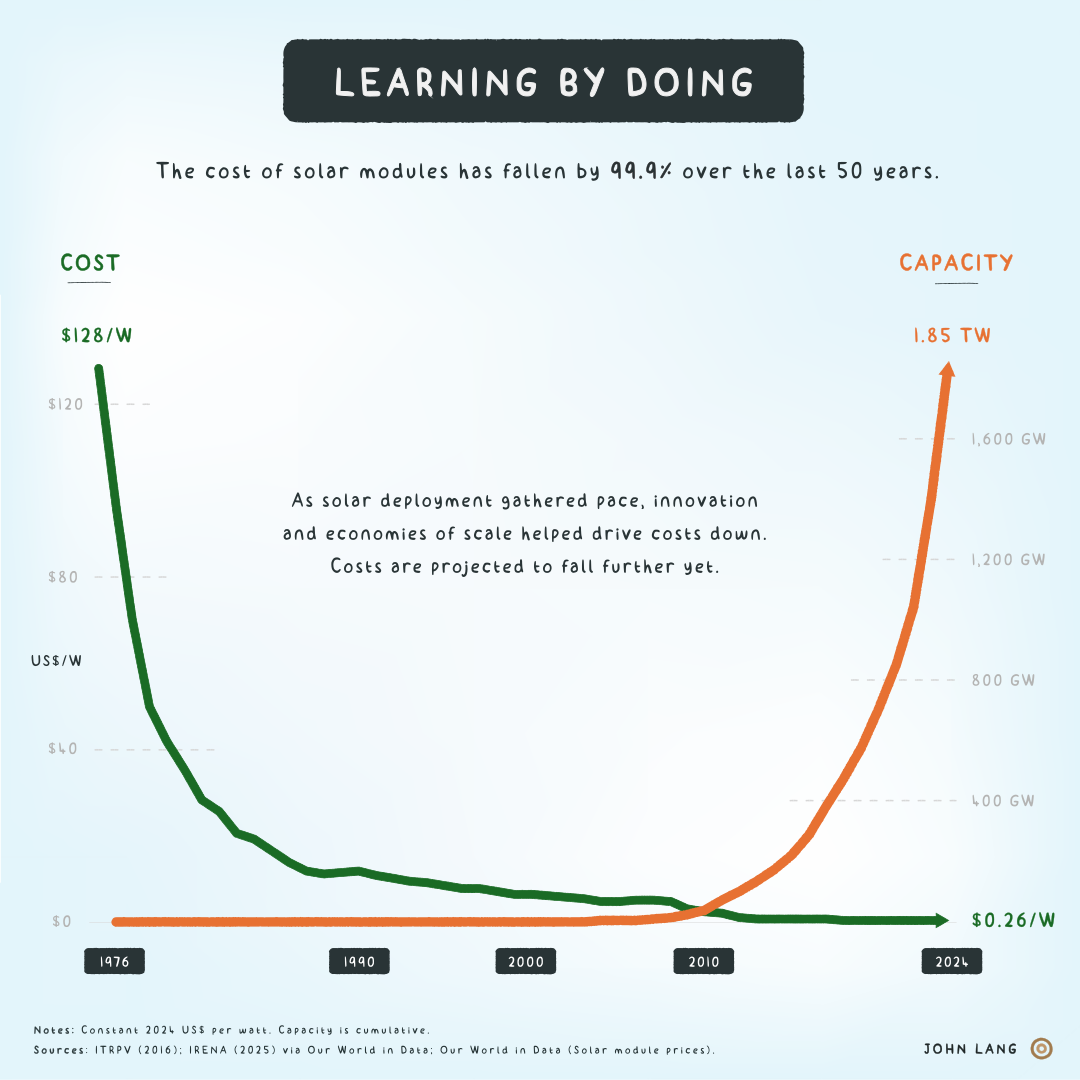
Our World in Data hosts the classic version, plotting solar prices against cumulative capacity on logarithmic axes. This graph tells the same story differently: as solar deployment accelerated – slowly at first, then exponentially – costs kept dropping.
Solar photovoltaic (PV) module prices fell by 88% between 2010 and 2025 and a seemingly absurd 99.9% since 1975 – from around $128 per watt to about 26 cents today. It was all because of relentless innovation, economies of scale, manufacturing expertise and policy support. As costs fell, deployment rose. As Ember likes to say, it took eight years for global solar generation to grow from 100 terawatt hours (TWh) to 1,000, then just three more to pass 2,000 TWh. (Global electricity demand is about 32,000 TWh.)
The learning isn't over. Analysts expect solar costs to fall by another 40% by 2035 as manufacturing scales more. Solar generation grew 30% in 2025, now matching nuclear's share of global electricity. All this momentum is thanks to China, which now produces over 80% of the world's solar panels. That massive scale has led to solar's incessant cost declines, even as other nations begin attempts to diversify supply chains away from China.
Why this matters
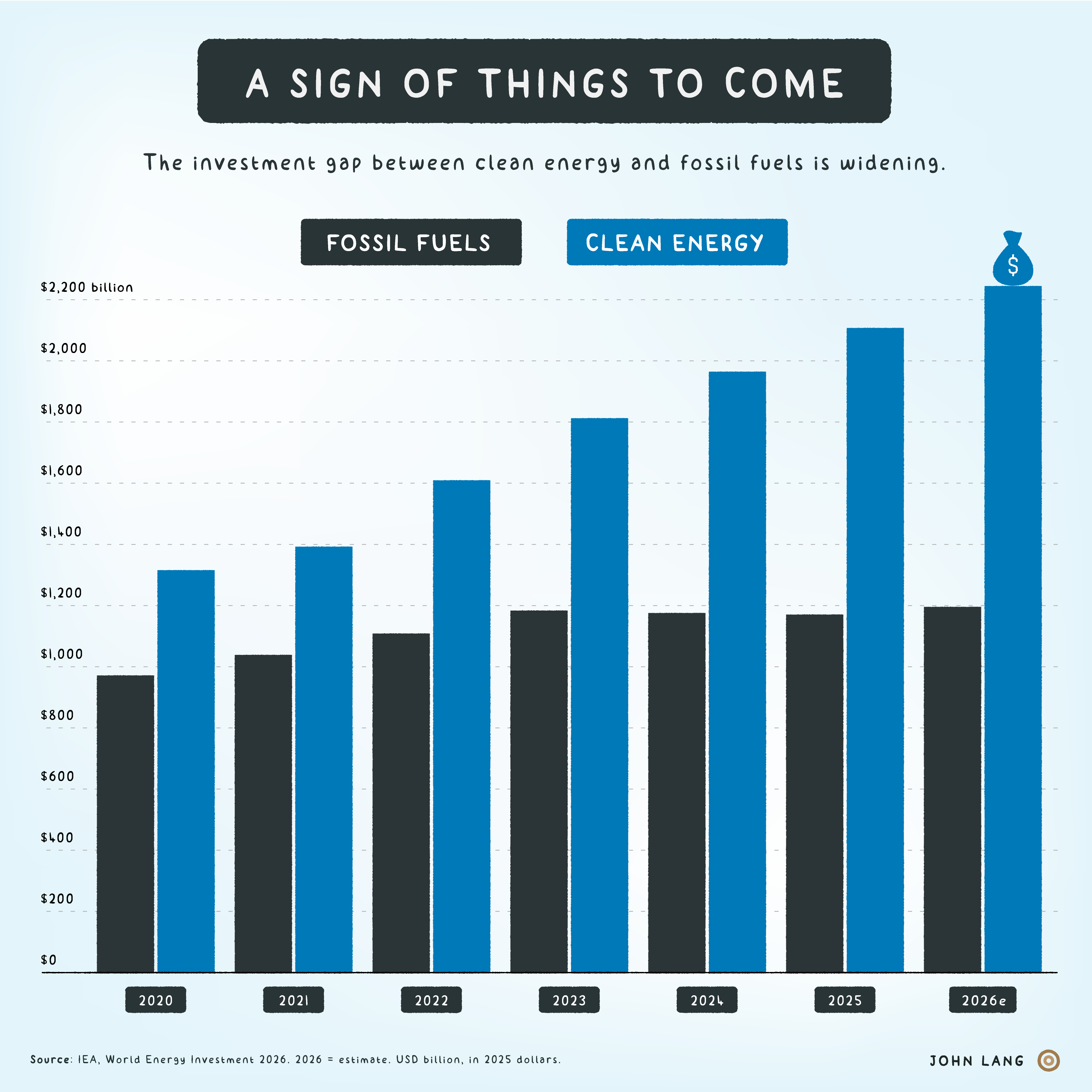
In 2025, clean electricity growth exceeded the increase in global electricity demand, keeping fossil generation flat. Solar alone supplied 75% of demand growth, while solar and wind together supplied almost 99%. That propelled renewables to generate 34% of global electricity, overtaking coal's 33% share.
At the same time, plummeting battery costs are turning daytime sunshine into round-the-clock electricity. Solar and batteries are fast becoming the energy transition's ‘killer app’: cheap, reliable and quick to deploy. But fully unlocking that potential means huge investments in grids, storage and demand flexibility. While grid investment is now rising by nearly 20% year-on-year, thousands of gigawatts of clean energy are stuck in grid connection queues or permitting delays, especially in the US.
Countries like China, India and Pakistan show how cheap solar can strengthen both energy security and affordability. Pakistan added 27 GW of distributed solar in just two years – the same as all the coal, gas and oil power plants ever built there. Around a quarter of Pakistani households now use solar panels, helping avoid an estimated $12 billion in oil and gas imports and shielding millions of families from volatile fossil fuel prices.
Lord Adair Turner, chair of the Energy Transitions Commission, puts it simply:
‘This is an unstoppable revolution driven by fundamentally superior technologies.’