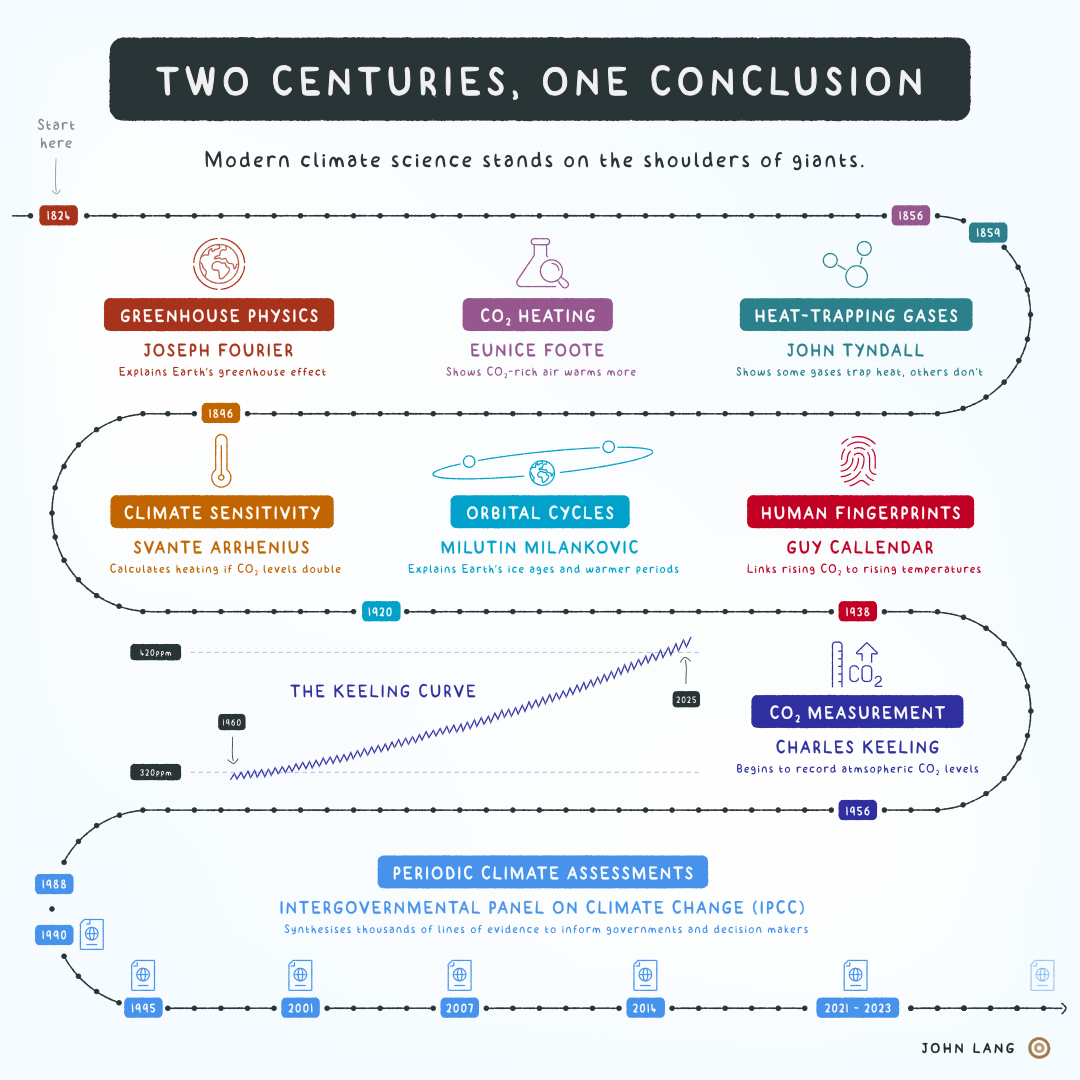
Modern climate science rests on two centuries of discovery, beginning in 1824.
About 200 years ago, French mathematician Joseph Fourier recognised that the atmosphere regulates Earth's temperature, trapping heat and making life possible. This natural greenhouse effect is one of the reasons we're the 'Goldilocks' planet: not too cold, not too hot. Without it, Earth would be a frozen ball of ice about 30°C colder than it is today.
Other discoveries eventually followed. In 1856, Eunice Foote, an American amateur scientist and women's rights activist, submitted a paper to the annual meeting of the American Association for the Advancement of Science. In it, she described a simple experiment: filling glass jars with different gases, including CO2. It showed that air containing more CO2 warmed more than stock standard air. Three years later, the Irish physicist John Tyndall explained the mechanism, demonstrating that certain gases absorb infrared radiation (heat) far more effectively than others. Foote's work lay largely unknown for more than a century, but belatedly received the recognition it deserved.
Near the turn of the 20th century, Swedish chemist Svante Arrhenius calculated, with prophetic accuracy, how much Earth could warm if CO2 levels in the atmosphere doubled. He also realised that burning coal for energy would likely influence our climate, but expected the effects to take much longer than they have to play out. He won the Nobel Prize for Chemistry in 1903.
Serbian mathematician Milutin Milanković developed his theory of Earth's orbital cycles during WWI, while interned by Austro-Hungarian forces. He published the first formulation in 1920, but his life's work didn't culminate until his magnum opus, Canon, was published during WWII. His ideas were initially met with scepticism and, like Foote’s, were only dusted off decades later. When corroborated, his calculations transformed our understanding of how Earth's climate changes naturally over millennia – moving between icy glacial and warmer interglacial periods. Those cycles, it should be said, do not explain today's rapid warming.
From theory to measurement
Long-term atmospheric monitoring closed the loop. In 1938, English engineer and amateur climatologist Guy Callendar brought temperature records and atmospheric CO2 measurements together to argue that burning fossil fuels was already warming the planet.
‘As man is now changing the composition of the atmosphere at a rate which must be very exceptional on the geological time scale, it is natural to seek for the probable effects of such a change.'
Then, in 1956, American geochemist Charles Keeling began the continuous atmospheric measurements that became the Keeling Curve, unveiling two stories at once: (i) atmospheric CO2 levels rising relentlessly, and (ii) the Earth ‘breathing’ in tune with the changing seasons. Wondering about the zig zag line above? Because most of Earth's land and vegetation reside in the Northern Hemisphere, photosynthesis draws down more CO2 from the atmosphere each spring and summer before levels rise again in the atmosphere through the autumn and winter.
Today, thousands of scientists assess and synthesise these and countless other lines of evidence through the IPCC process. All voluntarily.
A natural greenhouse effect makes Earth liveable. A human-enhanced greenhouse effect – driven by the release of 115 million tonnes of CO2 a day – is another ball game entirely.