Climate change is first and foremost an emissions problem. It’s also fast becoming a reflection problem.
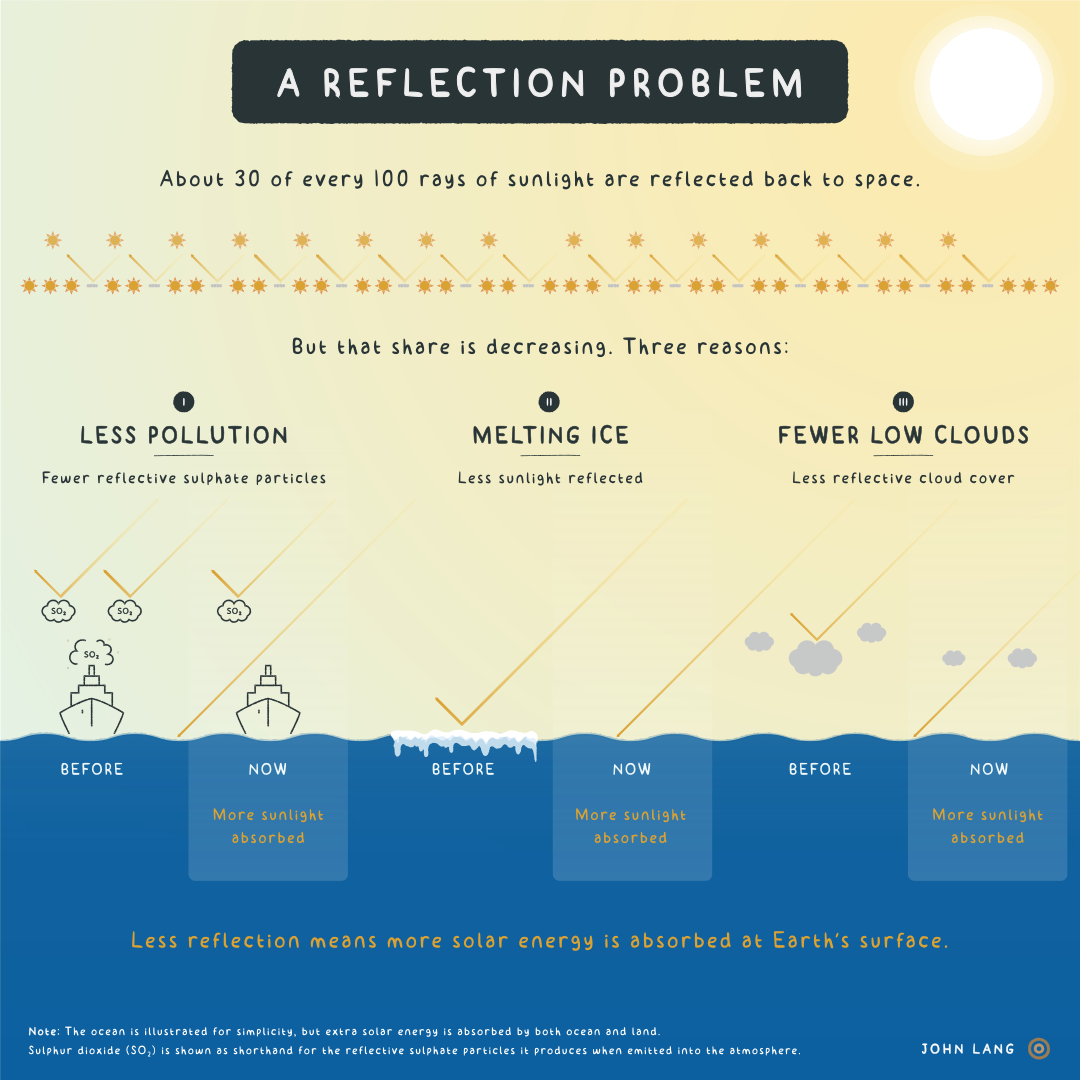
Scientists call Earth's reflectivity its albedo. Globally, about 30% of incoming sunlight is reflected back to space by bright surfaces and particles like clouds, ice, snow, white roofs and tiny airborne particles known as aerosols.
Over recent decades, these surfaces and particles have been reflecting less and less of the Sun’s energy. That’s a problem.
Evidence for this declining reflectivity comes from NASA's Clouds and the Earth's Radiant Energy System (CERES) satellites, which have measured the amount of sunlight absorbed by Earth and the amount of infrared energy emitted to space since the 1990s. The global Argo ocean float network confirms its observations, showing that more than 90% of the excess energy is ending up in the ocean.
Three changes have been contributing to Earth's declining reflectivity:
- Less pollution: Less sulphur dioxide (SO2) pollution spares lungs and saves lives. But it also means fewer reflective sulphate particles in the atmosphere. From 2020, new international shipping rules dramatically reduced SO2 emissions, weakening their cooling effect – especially over the open ocean.
- Melting ice: Ice sheets, sea ice and glaciers act like gigantic mirrors, reflecting sunlight back to space. As they melt, darker land and ocean are exposed, absorbing more sunlight and amplifying heating.
- Fewer low clouds: Low marine clouds are among Earth's most prolific reflectors. But recent research suggests they have declined in parts of the Northern Hemisphere and tropics, allowing more sunlight to reach the surface. Scientists think this reflects a combination of cloud feedback and adjustments to greenhouse gases and sulphate particles.
Why this matters
Every second, unfathomable amounts of solar energy arrive at Earth. To keep a stable temperature, the same amount of energy has to escape. When more energy stays than escapes, Earth stores the difference. Scientists call this Earth's Energy Imbalance (EEI), perhaps the most important metric in the whole of climate change.
Observations show that Earth's Energy Imbalance has more than doubled since 2000.
The Economist suggests we think of EEI like a balance sheet: sunlight is income, escaping heat is expenditure. If Earth balances the books, the temperature remains broadly stable. But when income is consistently more than what’s paid out, a surplus accumulates primarily in the ocean, but also in the atmosphere and land.
EEI is being driven by three changes. This visual focuses on one of them:
- More heat trapped by greenhouse gases and amplifying carbon-cycle feedbacks (the primary driver)
- More shortwave sunlight being absorbed because Earth is reflecting less
- Less longwave heat escaping because of water vapour and high-altitude cloud changes.
Understanding why Earth's reflectivity is changing can help scientists refine estimates of climate sensitivity – that is, how much Earth's temperature will rise in response to a given increase in atmospheric CO2 (usually a doubling of CO2 from preindustrial levels).
Observations of EEI also provide a stress test of climate models, helping scientists better understand whether they're accurately capturing climate feedbacks. How strongly different clouds amplify or dampen heating, for example, is still one of climate science's cloudiest questions.