The Paris Agreement temperature goals are politically agreed guardrails, not hard scientific boundaries. Every additional 0.1°C of heating increases risks, and every additional 0.1°C avoided reduces them.
The public narrative sometimes treats 1.5°C or 2°C of heating (above the pre-industrial average) like cliff edges, as if crossing them triggers a plunge into global disaster. That was never their intent. Climate change outcomes are not binary. These goals were designed to limit risk in a world where impacts rise steadily with every additional 0.1°C of heating. Each fraction of a degree brings more heat, more energy imbalance, more extremes and more pressure on societies and ecosystems.
As the late climate scientist Stephen Schneider put it: “The ‘end of the world’ or ‘good for you’ are the two least likely among the spectrum of potential climate outcomes.” It’s the wide middle ground we’re playing for.
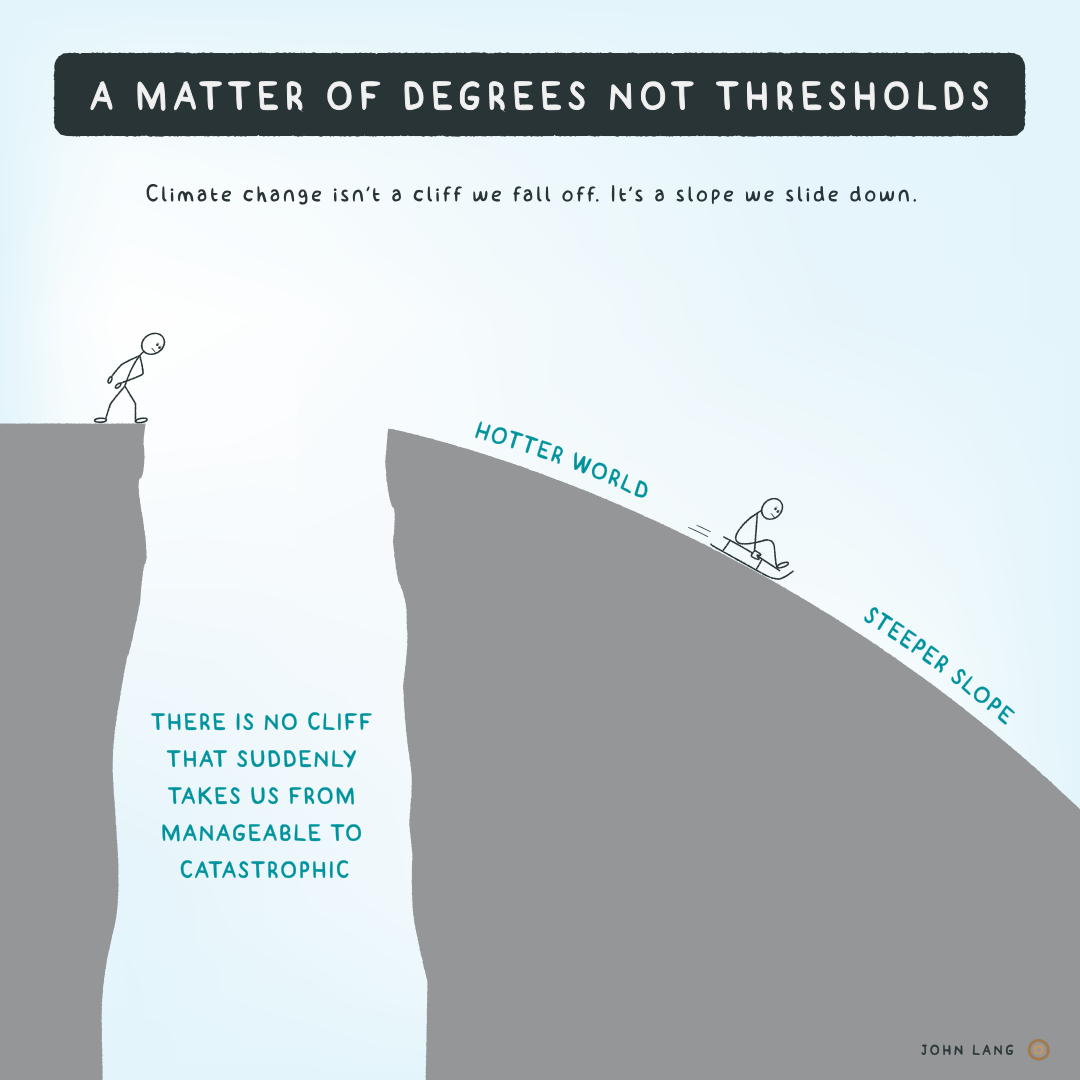
The above graphic is inspired by US climate scientist Kate Marvel, who wrote in Scientific American:
‘Climate change isn't a cliff we fall off, but a slope we slide down.'
Human-caused heating doesn't take us from manageable to unmanageable overnight. Instead, the hotter the world gets, the steeper the slope becomes and the harder it is to stay in control. Climate change is simply a series of risks that we do not have to take.
Projecting the future climate is partly a question of risk management under uncertainty. How much heating ultimately occurs depends on future cumulative emissions, the sensitivity of the climate system to those emissions and the strength of carbon-cycle feedbacks – such as thawing permafrost and weakening natural carbon sinks – that can amplify heating.
But what about climate tipping points?
Some parts of the Earth system – including the Greenland ice sheet, Atlantic Meridional Overturning Circulation (AMOC) and ecosystems such as the Amazon rainforest and coral reef systems – are likely to contain critical thresholds beyond which change becomes self-perpetuating and fiendishly difficult or impossible to reverse on timescales relevant to humans. These tipping points are not 'game over' moments. They're additional risks that tilt the slope steeper and make the challenge of stopping or reversing harder.
Scientists know these thresholds exist, just not exactly where they exist. Every additional tenth of a degree of avoided heating therefore matters for two reasons: it reduces climate impacts directly and lowers the future risk of triggering irreversible changes in Earth systems. As climate scientist Zeke Hausfather has noted, many of the most dangerous tipping points are still avoidable.
Tipping points are not only found in the Earth system. Societies can also reach positive tipping points. Public norms, technologies and policies can spread through self-amplifying feedbacks of their own. Solar power, EVs, net zero targets and climate laws are already following this pattern. Our climate future will be shaped by social, cultural and technological tipping points as much as geophysical ones. Indeed, stronger climate policy and the clean energy revolution have already moved us away from the most dystopian climate futures.
The choices governments and societies make now can reduce future risks by limiting the roughly 115 million tonnes of CO2 emitted into the atmosphere every day. That means steadily turning the tap of emissions down.