Setting a target brings scrutiny. Good. But credible efforts to deliver that target should bring recognition.
Almost two-thirds of the Forbes Global 2000 now have net zero targets, covering more than $36 trillion in annual revenue. Net zero is a corporate norm, despite some politicians dismissing it as the latest 'wokery' and others as set-and-forget value signalling.
Voluntary targets create accountability. The moment a firm makes a promise, analysts like us at the Net Zero Tracker should interrogate and time-stamp it: What emissions does it cover? Is there a credible plan? Is accountability baked in? What happens if it falls off track? That's what targets are for.
The same principle applies to governments: a public pledge gives citizens, journalists and analysts something concrete to hold them to.
The accountability asymmetry
But there’s an awkward asymmetry in corporate climate accountability. The companies that say the most can end up receiving the most scrutiny, while those that say nothing offer would-be scrutineers little to hold them to. Exhibit one: state-owned enterprises. Exhibit two: private firms. Both operate more in the shadows than their publicly listed counterparts, and typically face less accountability as a result.
The rules for companies that do make commitments have grown more stringent. The UN High-Level Expert Group’s Integrity Matters formally set out what credible voluntary pledges should contain in 2022: interim targets, full emissions coverage, transition plans, fossil-fuel phase-out, annual progress reporting and aligned lobbying.
New and updated international standards are tightening the screws on accountability, while allowing more flexibility on delivery. SBTi’s Corporate Net-Zero Standard 2.0 requires annual reporting and periodic assessment of progress, barriers and corrective actions — including where emissions diverge from targets — as part of a ‘continuous improvement process’. The draft ISO Net Zero Standard looks at both targets and delivery against them, and whether companies are making credible, verifiable progress.
All welcome developments. But there’s a catch: the companies making commitments also give us the most to scrutinise.
When targets meet reality
As a 2030 reckoning approaches for near-term targets, getting the incentives and rewards right in advance matters. Some companies will miss their interim targets. That doesn't automatically mean those targets were cynical or exercises in greenwashing. Google offers a glimpse into the problem: its AI infrastructure is growing faster than the grid is decarbonising, even as it signed a record 12 GW of new clean energy in 2025.
And companies operate inside systems: electricity grids, supply chains, transport networks and policy environments. No firm can decarbonise the energy or food system alone. (That’s why activating corporate Spheres of Influence is so important – soon to be the topic of a Trunk visual.)
Companies that fall off track then face a choice: ditch the target, change it, or keep quiet and hope nobody notices. For years, we've needed an honest conversation about what responsible course correction looks like – without making silence or ‘greenhushing’ the safest reputational option.
Those of us holding companies to account ought to get better at distinguishing between missing a target, weakening a target and never having one in the first place.
Three hierarchies
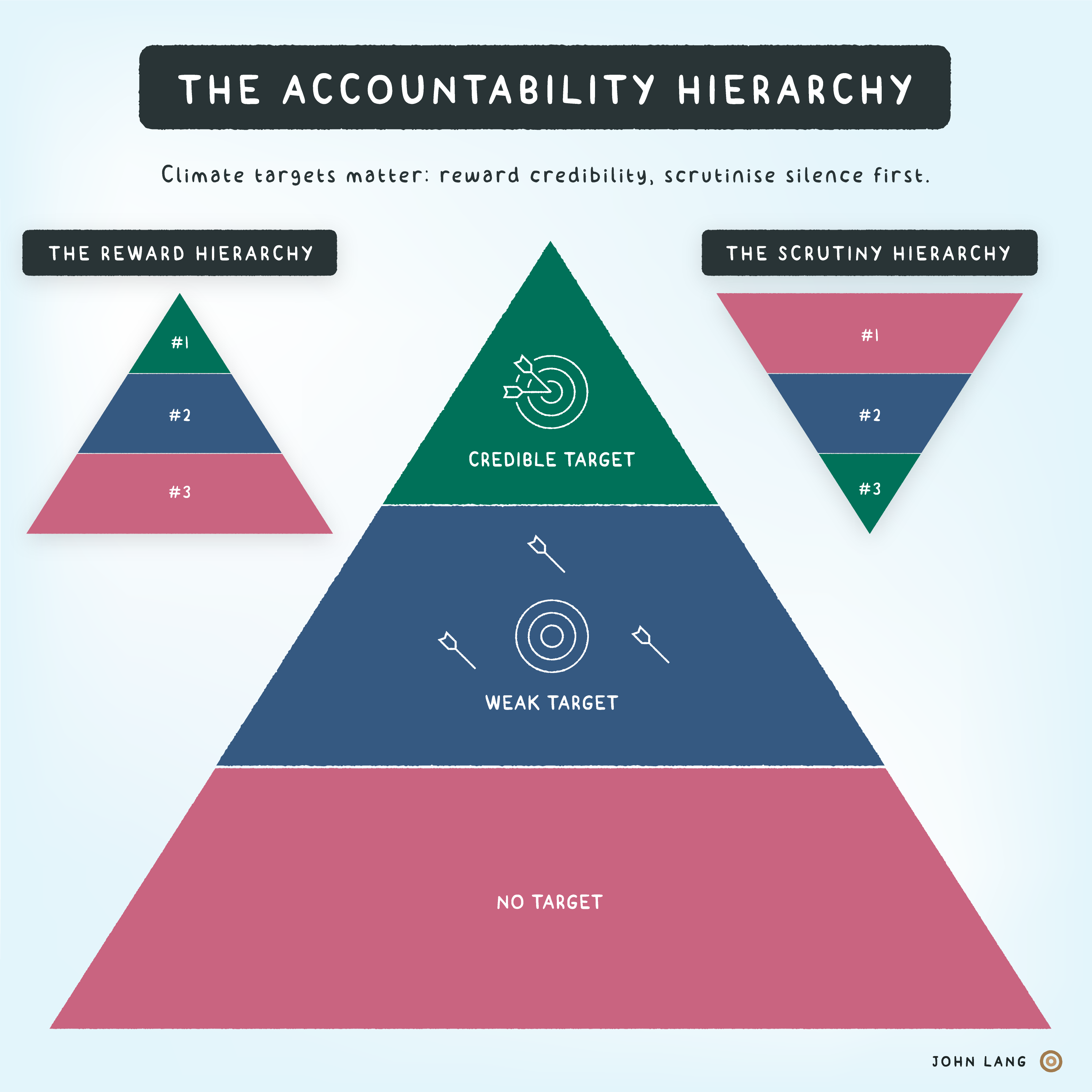
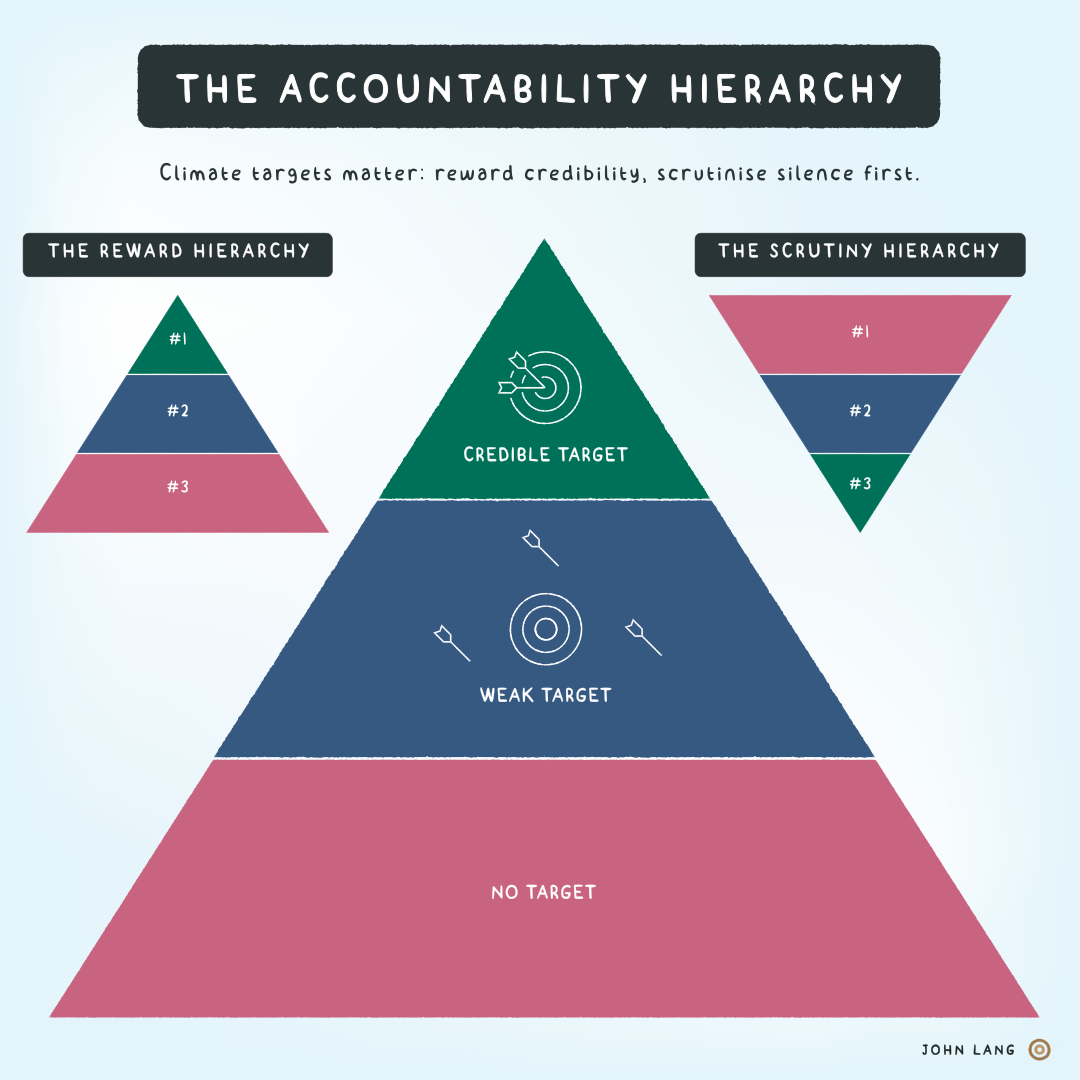
Climate accountability could do with three hierarchies: an accountability hierarchy, then two ways of looking at it.
- The accountability hierarchy:
- Credible target backed by near-term milestones, full emissions coverage and, importantly, a plan to deliver it.*
- Target, but weak or incomplete.
- No target.
- The reward hierarchy: Recognise firms setting credible targets, demonstrably acting on them and transparently reporting progress. Name and fame.
- The scrutiny hierarchy: Invert the pyramid and scrutinise silence first. Companies without meaningful mitigation targets shouldn't escape scrutiny simply because they haven't pledged. Name and shame? That should be on the table.
None of this means going easy on companies (or governments) with targets. Commitments, be those genuine or greenwash, should invite scrutiny. But that scrutiny should come with recognition when companies deliver, improve their plans or, importantly, honestly explain where they're falling short, why, and what’s needed to get back on track. That might mean stronger policy, say, or better grid infrastructure.
Otherwise we risk creating, or maintaining, a perverse incentive: the safest climate target is no climate target at all.