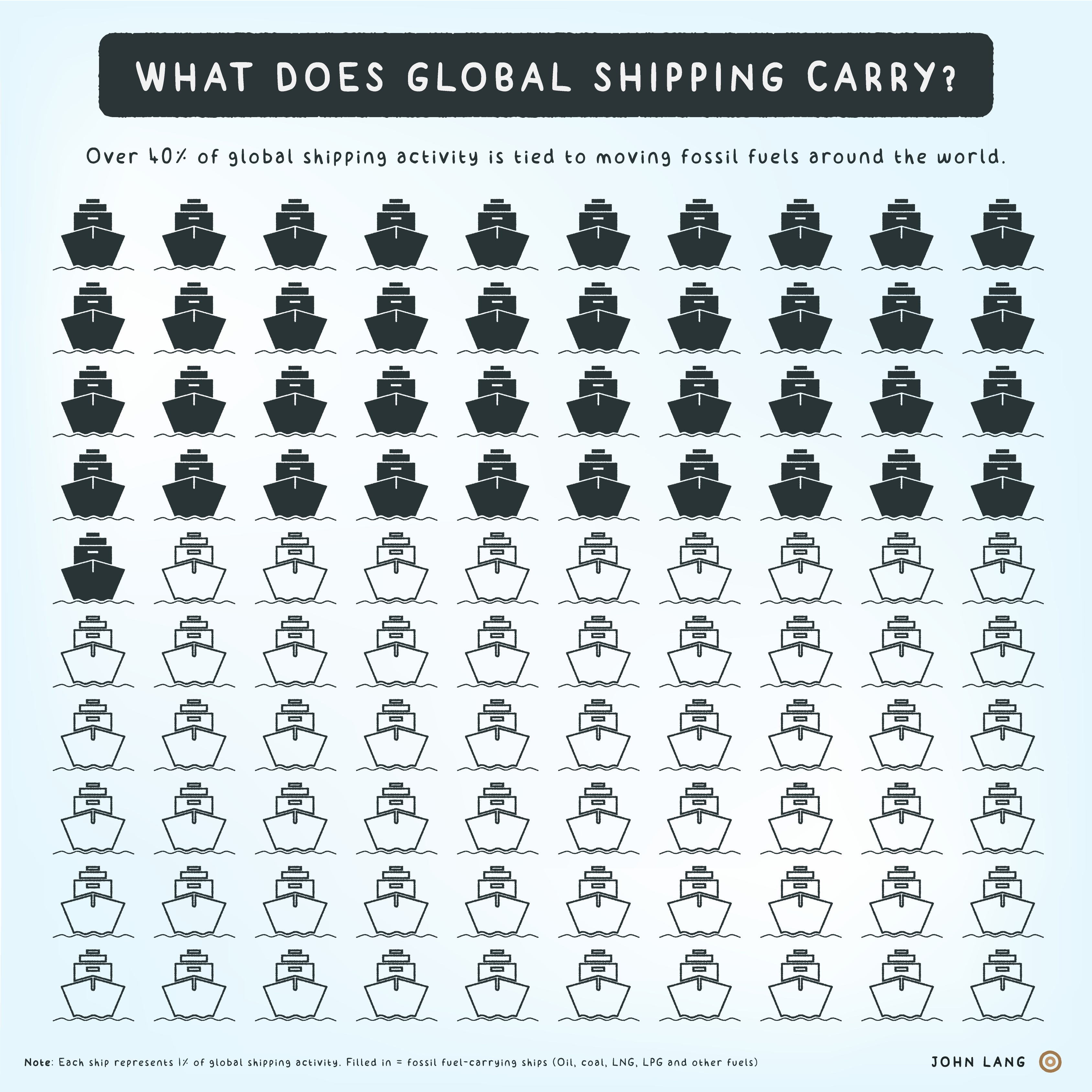
Fossil fuels are both fuel and freight for the shipping industry.
Shipping carries more than 80% of global trade by volume and around 70% by value, while producing roughly 3% of global greenhouse gas emissions.
About 41% of global shipping activity is tied to moving coal, oil and gas (and their derivatives). The global deployment of clean energy will change what powers ships. It will change what they carry and where they sail, too.
UCL research estimates that the existing and ordered fleet carrying fossil fuels is worth around $875 billion. How much of that value is ultimately at risk depends on how quickly fossil fuel demand falls and how readily ships can be repurposed. Under a rapid transition scenario, separate UCL modelling shows that more than one-third of the wider global fleet by value – over $400 billion – could face premature scrapping without retrofits.
By way of context, the global merchant fleet numbers about 112,500 commercial vessels (100 gross tons and above).
LNG tankers may be the clearest example. Being highly specialised, they have relatively few options for carrying other stuff. The UCL modelling found that over a quarter of LNG and LPG tanker fleet value could be left idle by around 2030 under an ambitious 1.5°C-aligned scenario – illustrating the potential for oversupply as fossil-fuel demand declines.
Geopolitical shocks add another obvious layer of risk, as the Strait of Hormuz disruption has shown. The volatility of fossil fuels is part of a new energy calculus for nations that are prioritising resilience, sovereignty and reduced exposure to global fuel markets.
A smaller cornucopia of goods
As fossil fuel cargoes decline, shipping will carry less energy by volume, but more of the key minerals needed to produce it cleanly. Cobalt, copper, lithium and nickel will become ever more important, while new trades could emerge in green iron, ammonia, methanol and other products made using abundant renewable electricity.
Renewable energy will eventually sail the world en masse, embedded in materials and new low-carbon fuels. Ports will have to change too, becoming hubs for batteries and storing new fuels, while new ‘green shipping corridors’ could connect places able to produce clean fuels and materials with new markets that need them.
A structural challenge for the industry
Some fossil fuel-carrying vessels could be retrofitted or repurposed. Others may leave shipowners, financiers and insurers exposed as clean energy eats into fossil fuel demand.
Uncertainty over the future fuel mix complicates investment. According to UCL, one way to hedge that risk is through dual-fuel vessels, particularly where one option is a scalable zero-emission fuel.
Sail-powered hybrids already use rigid wings, rotor sails and other wind-assisted systems to cut fuel use. Ammonia and methanol are the leading alternative fuels, but green versions need vast amounts of clean energy. Green ammonia, for instance, relies on green hydrogen – still expensive and extremely inefficient to produce – at a time when almost all the hydrogen we use today still comes from fossil fuels.
Globally coordinated policy is lagging too. The International Maritime Organization failed to adopt its proposed Net Zero Framework in 2025, amid strong US opposition and threats against countries supporting it. The meeting was adjourned for a year. The framework was already a watered-down compromise, but it would help create a global market for cleaner shipping fuels and channel revenues towards infrastructure, technology transfer and a just transition in developing countries.
Negotiations were put back on track in 2026, with many IMO member states continuing to support the existing framework as the 'basis for further work'. Its final form is unresolved.
However it all plays out, the currents of global trade will shift. As the world burns fewer fossil fuels, shipping should become lighter.