Net zero is the only way to stabilise rising temperatures.
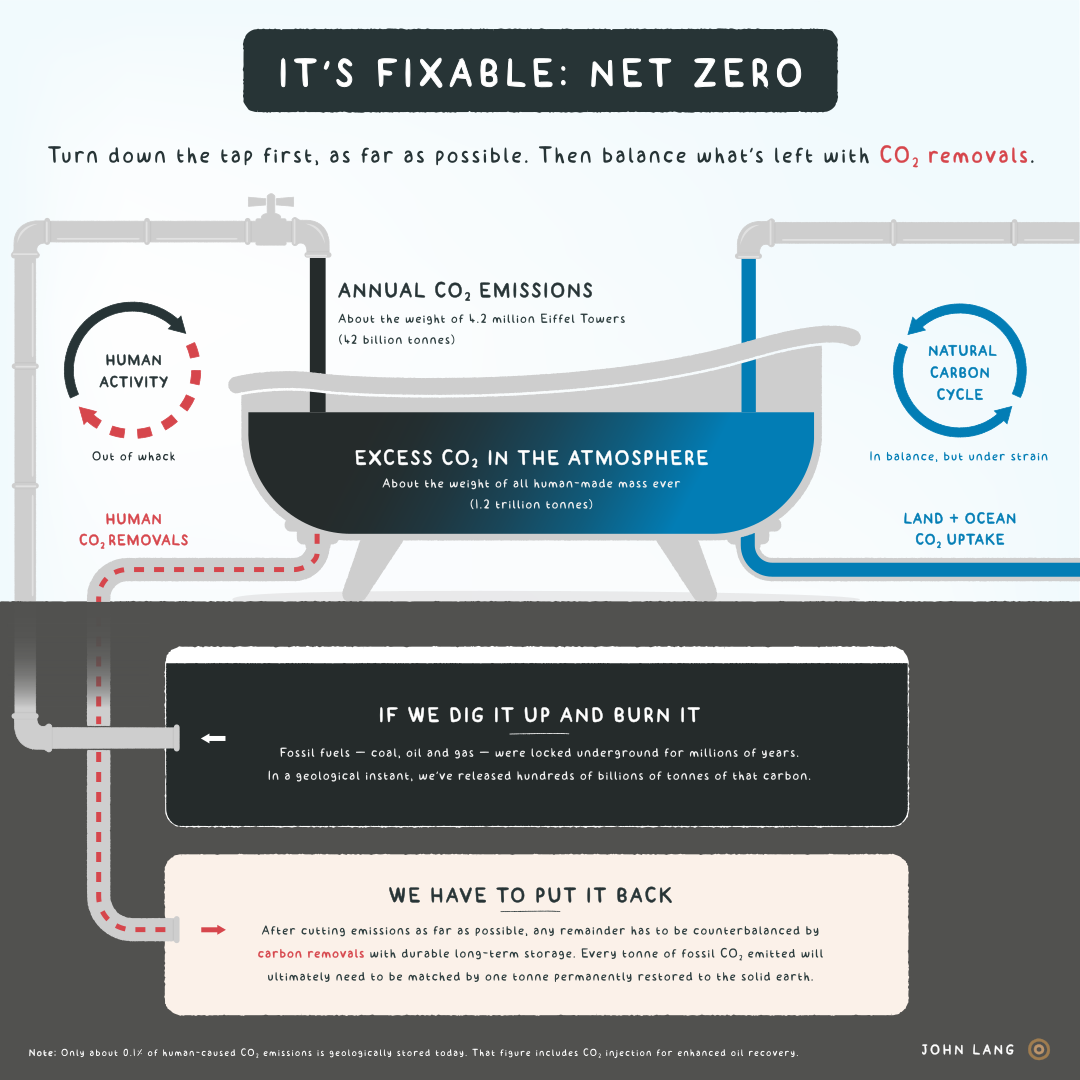
As the above visual shows, this means turning the emissions tap down as far as possible, then counterbalancing what’s left with durable carbon removals.
Carbon dioxide accumulates in the atmosphere like water in a bathtub: its heating effect is cumulative. As long as more goes in than comes out, the level keeps rising and temperatures keep climbing. When inflows and outflows are brought into balance, excess CO2 stops building up and temperatures are expected to stabilise.
Net zero only works if we also maintain the land and ocean sinks shown on the right of the graphic, which already take up more than half (around 56%) of the CO2 we emit each year. We must protect these sinks because we are counting on them to continue hoovering up CO2 even as human emissions fall.
That’s why cutting emissions is necessary, but cutting them alone is not sufficient. Atmospheric CO2 is extraordinarily long-lived: about half of what we emit today will still be in the atmosphere in 100 years, and a small fraction will last up to 400,000 years. Even if global emissions fell by, say, 80%, excess CO2 would still build up, and heating would continue – just more slowly.
Net zero stops the accumulation. To keep the Paris Agreement’s temperature goals alive, global CO2 emissions need to be cut by as much as 90%, with removals counterbalancing the emissions that cannot readily be eliminated – known as ‘residual emissions’. In a geological net zero world, any fossil carbon we dig up and burn ultimately has to be put back underground – a 'like-for-like' balance on similar timescales.
Once human-caused CO2 emissions reach net zero, ocean heat uptake will slow while land and ocean sinks continue drawing down CO2 from the atmosphere. These effects are expected to largely cancel each other out, meaning surface temperatures should stabilise.
Going further – to net zero greenhouse gases and eventually net negative emissions – would bring temperatures down. But net zero CO2 is the first step.
Carbon removals cannot do the heavy lifting. Many approaches are still early-stage, costly and unproven at scale – hence the dotted red line above. Cutting emissions now is easier and almost always cheaper than trying to remove them later. But removals are a vital supporting tool and must be invested in and scaled to industrial levels by mid-century at the latest.
Net zero in four nutshells
Achieving net zero CO2 emissions in the next three to four decades means:
- Replacing fossil fuels with clean energy
- Electrifying energy systems as fast as possible
- Protecting, restoring and strengthening the land and ocean sinks that underpin the natural carbon cycle
- Scaling up durable carbon removal to industrial levels.
Net zero isn’t a political slogan – it’s physics and chemistry. And it’s the only way to stop global heating.