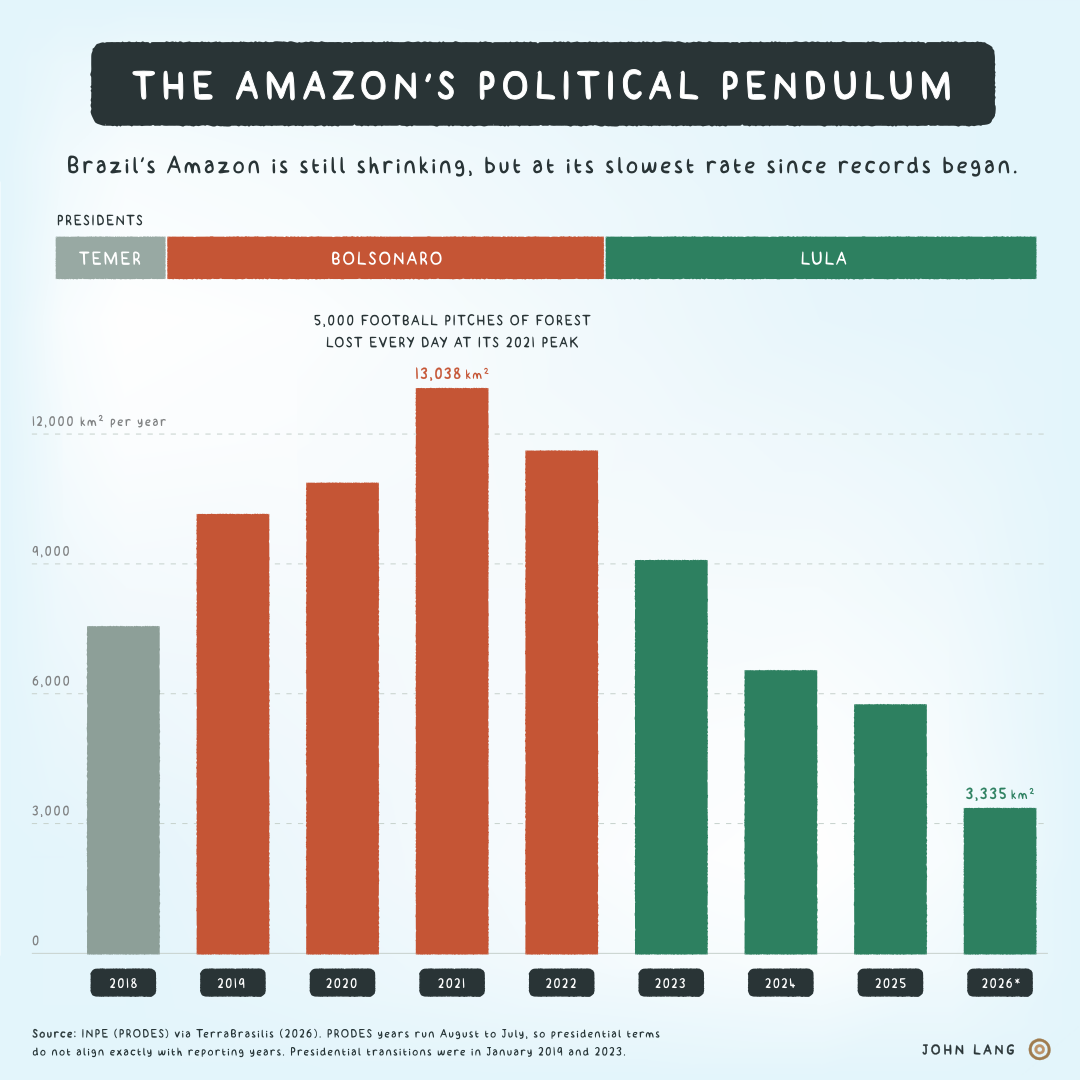
Deforestation in the Brazilian Amazon has fallen to its lowest level since satellite records began in 1988. With a presidential run-off days away, the world's largest tropical rainforest faces an uncertain future.
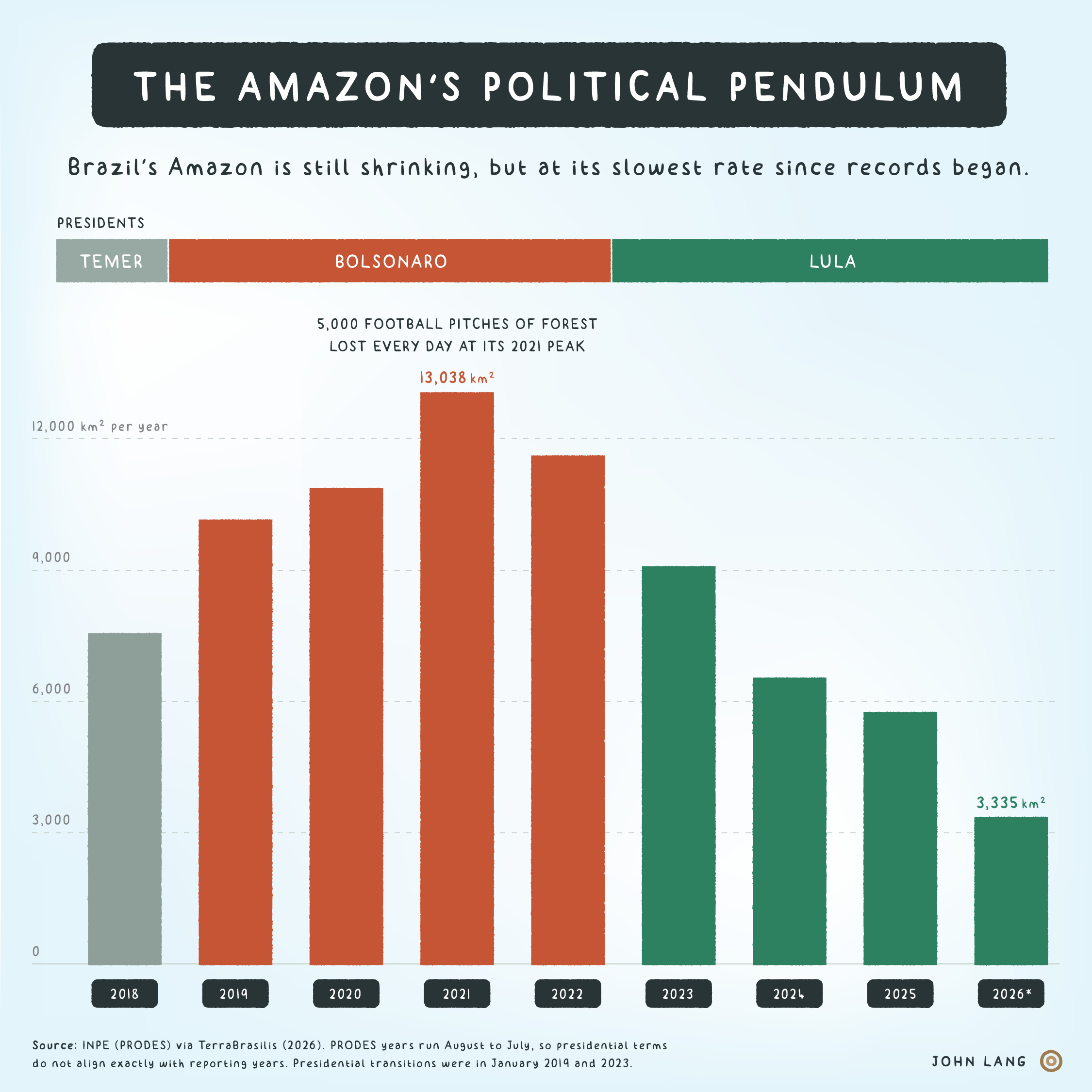
Deforestation took off under Jair Bolsonaro. Forest loss rose by 60%, as his administration weakened environmental enforcement and cut forest protections. President Lula, who returned to office in January 2023, helped reverse the trend.
In the 12 months to July 2026, deforestation in the Brazilian Amazon plummeted to 3,335 square kilometres. That's 71% below where it was in 2022, Bolsonaro's last year as president.
What changed?
Three things, in particular:
- Stronger enforcement. Lula's government rebuilt environmental agencies, increased inspections and penalties, and brought action against illegal logging, mining and land grabbing.
- Targeting hotspots. Enforcement has improved in high-deforestation regions, including Pará and Mato Grosso. These two states collectively account for almost 60% of Brazilian Amazon deforestation, yet both have seen reductions of more than 45% compared with 2025.
- Restoring forest protection. Lula's government revived its Amazon deforestation prevention programme, strengthened Indigenous protections and renewed its pledge to end illegal deforestation by 2030.
The visual shows the decline began in 2022, during Bolsonaro's final year in office. Government policy is important, but annual changes cannot be attributed to presidents alone. Commodity prices, enforcement, rainfall, drought and other factors all impart influence.
A global non-negotiable
To reach global net zero and stabilise global temperatures, ending deforestation and protecting carbon sinks must go hand in hand with phasing out fossil fuels. Net CO2 emissions from land-use change, including deforestation, dropped to 4.1 billion tonnes in 2025 – still about 10% of human-caused CO2 emissions globally.
Clearing forests for cattle pasture alone accounts for a gobsmacking 41% of global commodity-driven deforestation. Most of it is in Brazil.
More than a carbon store
It spans nine South American nations and covers almost 7 million square kilometres.
The Amazon is a photosynthesis powerhouse, a giant carbon store, a treasure trove of biodiversity and a regulator of rainfall.
It's a continent-sized water pump. Its trees move moisture from the soil into the atmosphere, helping sustain rainfall that supports agriculture, water supplies and hydropower, Brazil's largest source of electricity.
What happens when the water pump starts to fail? A 2026 Nature study found that global heating of 1.5 to 1.9°C above pre-industrial levels, combined with deforestation of about 25%, could trigger ‘cascading transitions’ across more than two-thirds of the Amazon forest. (These are modelled risk thresholds, not predictions.)
Forest loss is a big part of the Amazon story, but not the full story. PRODES, this visual's data source, mainly measures clear-cut deforestation. It misses much of the damage caused by fires, drought and logging, which can severely degrade forests without removing them entirely, as the devastating fires of 2024 demonstrated.
‘Deforestation control policies alone [...] are insufficient to preserve biodiversity and carbon and safeguard forest-dependent livelihoods.’ – Cammelli et al, 2026
It’s economics, stupid
Beef production in Brazil has been the largest driver of global deforestation in recent decades. Clearing a football field's worth of forest can generate immediate profits, whereas keeping it standing delivers benefits that markets seldom reward.
Launched at the UN climate summit in Belém, Brazil, the Tropical Forest Forever Facility (TFFF) is designed to change the calculus by providing long-term finance to countries with tropical forests. Using returns on invested capital, it aims to reward governments for keeping forests standing, recognising their global benefits.
Bringing down deforestation in the Brazilian Amazon has taken years. But – as all people of all generations know – cutting something down is easier than building it back up.
Notes: Jair Bolsonaro served from Jan 2019 to Dec 2022. Lula took office in Jan 2023. PRODES deforestation years run from August of the previous year to July of the named year – meaning they do not align exactly with presidential terms.
Brazil faces a presidential run-off on 25 October. The two candidates offer very different approaches to Amazon protection.