Net zero. Carbon neutral. Climate positive. Different names for the same thing?
They're sometimes used interchangeably. But look under the hood and big differences emerge, including when we can stop global temperatures from rising and when we might start bringing the global thermostat back down.
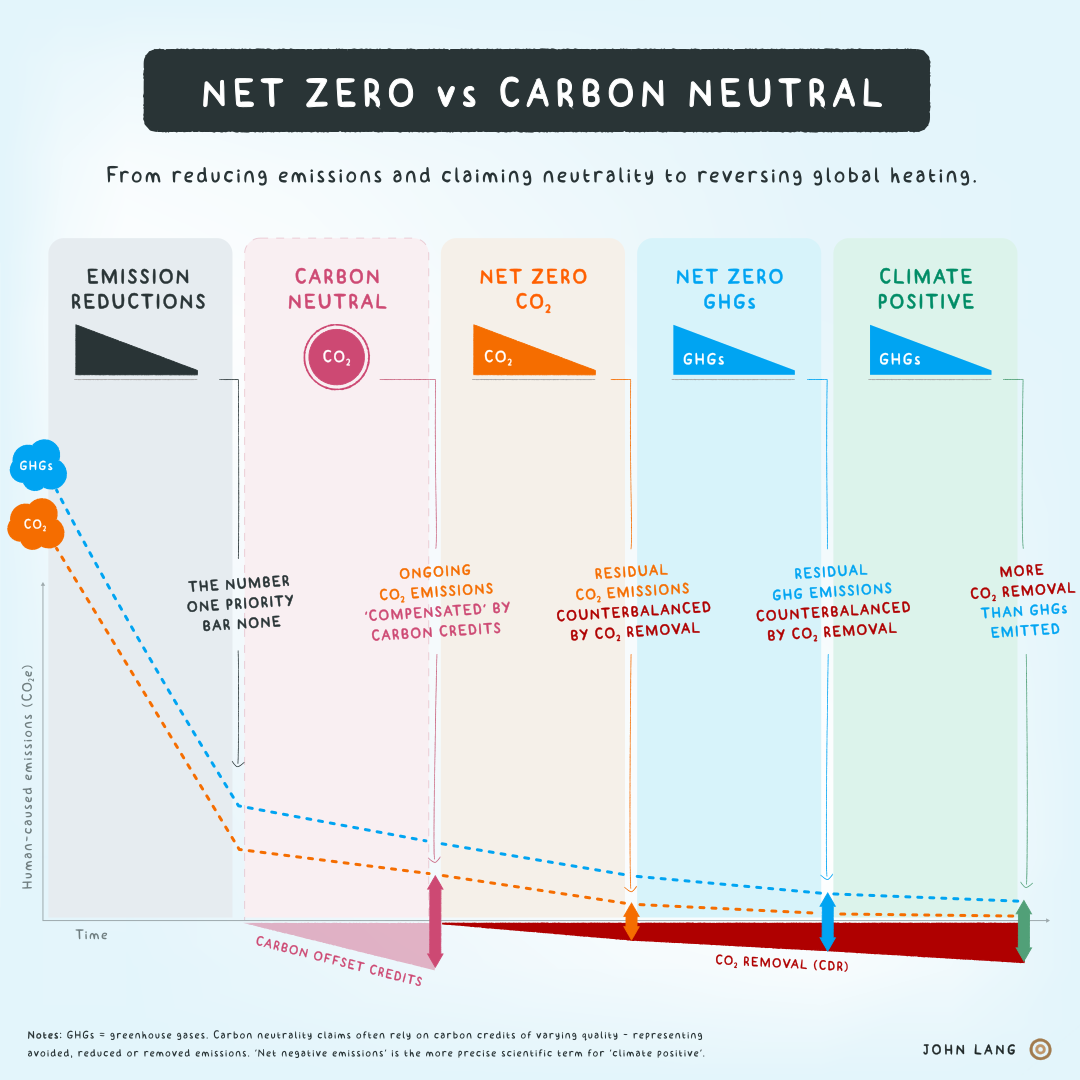
Net zero means cutting emissions as far as possible, then counterbalancing what's left with carbon removals. Carbon neutrality, at least as some companies claim it, means carrying on emitting while buying carbon credits* to ‘compensate’ for those emissions. But buying credits doesn't vaporise the original emissions.
There's no shortcut to net zero
Carbon dioxide (CO2) accumulates in the atmosphere like water in a bathtub. As long as more goes in than comes out, the level rises, and more heat is trapped. Cutting emissions slows the rate at which the bathtub fills. But to stop the accumulation, we need to reach net zero CO2: a balance between the CO2 humans emit and the CO2 we deliberately remove from the atmosphere.
Deep emission cuts have to do the heavy lifting. Emission reductions account for at least 80% of the effort in cost-effective Paris-compatible pathways.
Carbon removal has to play a supporting role, counterbalancing the ‘residual emissions’ we can't readily eliminate – for example, by techniques that hoover up CO2 and store it securely for centuries or more.
The amount needed? Almost unfathomable.
One gigatonne (Gt) is a billion tonnes – equivalent to the weight of about 200 million African elephants. Some pathways require removing five gigatonnes (or more) of CO2 annually by mid-century. That's a billion elephants, every year.
Carbon neutral and its imaginary commodity
According to the IPCC, carbon neutral and net zero CO2 are scientifically synonymous. They both mean human-caused emissions balanced by human removals, with that balance maintained thereafter.
But move into the world of transactions and carbon neutrality can mean something quite different. A company might continue emitting CO2 while purchasing carbon credits from projects that claim to prevent emissions elsewhere – for example, by protecting a forest or financing renewable energy.
Carbon credit projects can deliver benefits – supporting local communities and protecting biodiversity, for instance. But the devil is in the accounting. Many have been criticised for overstating their impact or claiming reductions that would have happened anyway. As a university lecturer once put it, only half satirically:
'Offsets are an imaginary commodity created by deducting what you hope happens from what you guess would have happened.' — Dan Welch, University of Manchester
For a carbon credit to mean more than the paper it's written on, its climate benefit needs to be real, independently verified, additional to what would have happened anyway, not double counted and long-lasting. But even a high-quality credit for avoiding emissions elsewhere doesn't remove the CO2 you've already emitted.
Avoided emissions depend on what would have happened without the project – a counterfactual that's nigh impossible to truly verify. And even then, genuine avoidance helps the climate, but it doesn't cancel out emissions already released into the atmosphere.
Net zero CO2 vs net zero GHGs
CO2 doesn't do all the heat-trapping. Other human-caused GHGs – including methane, nitrous oxide and F-gases – also trap heat, but in different ways and over different timescales. As climate scientist Joeri Rogelj demonstrates, the distinction matters for global temperatures:
- Net zero CO2 means balancing residual CO2 emissions with CO2 removals. Global temperatures broadly stabilise. (Provided other greenhouse gases are also reduced.)
- Net zero GHGs goes further, accounting for all greenhouse gases. Because some non-CO2 emissions are hugely difficult to eliminate, reaching net zero GHGs generally requires additional CO2 removal to counterbalance them. Global temperatures should peak then gradually decline.
Climate positive?
It describes going beyond net zero, so removing more CO2 from the atmosphere than GHGs emitted (measured in CO2-equivalent** terms). ‘Net negative emissions’ is more scientifically precise – but less appealing for obvious reasons.
The number one priority bar none
CO2 removal is essential for stabilising global temperature and, one day, for turning down the global thermostat.
But it cannot substitute for cutting emissions at source. The less we emit today, the less we'll need to remove from the bath tomorrow.